Nikon digital single reflex cameras(and which lens will fit)Introduction
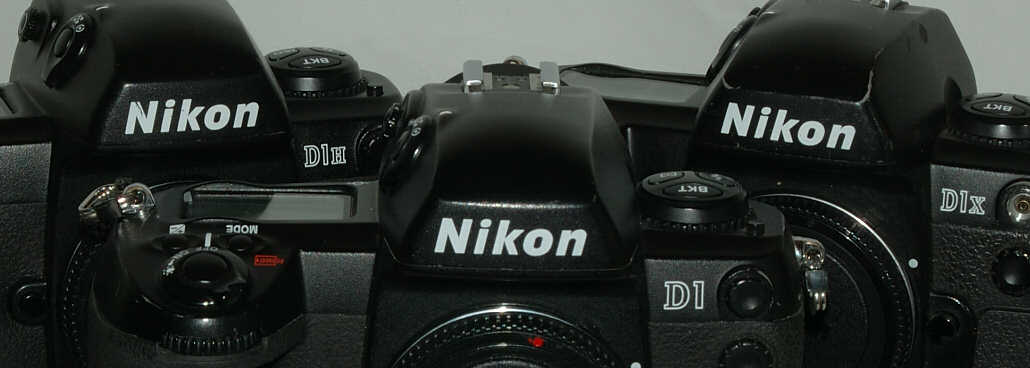
Since a German technician developed a ´miniature´ camera for the 35mm cine-film in the first half of the last century, many camera manufacturers followed with an similar design. The first Nikon rangefinder camera was more or less a copy of that German invention. The first Nikon single lens reflex camera, the Nikon F, is in fact a rangefinder camera fitted with a mirror house and eye level view finder. And the first digital reflex camera is almost a copy of one of the last film SLR´s Nikon made. If you would open the Nikon D1 you´ll find the film compartment intact. Many manufacturers have shown that the shape of a modern digi-reflex camera doesn´t need to follow the classic film SLR design. Nikon Corporation - however - is one of the conservative camera makers´ herd. Digital technology makes it possible to create an image taker (´camera´ isn´t a proper name anymore) with a better grip, giving space to our nose and eyes so we can press the IT-camera at our cheek for better stability, or - like mounted on modern movie cameras - fitted with a moveable viewing tube. As you will see in this chapter Nikon digital SLR´s do have the same shape as their film cousins. All made for right-handed people only, but luckily with the F-mount enabling to use nearly all Nikkor lenses. Before Nikon introduced a professional digital single lens reflex (SLR) camera other manufacturers produced digital cameras on basis of a Nikon film SLR. Cameras have been made by Kodak, Fuji and others on basis of the Nikon F3, F4, F5, F-801, F-90, Pronea, etc. Some in cooperation with Nikon, some not. More info about the Kodak and Fuji SLR's can be found here.
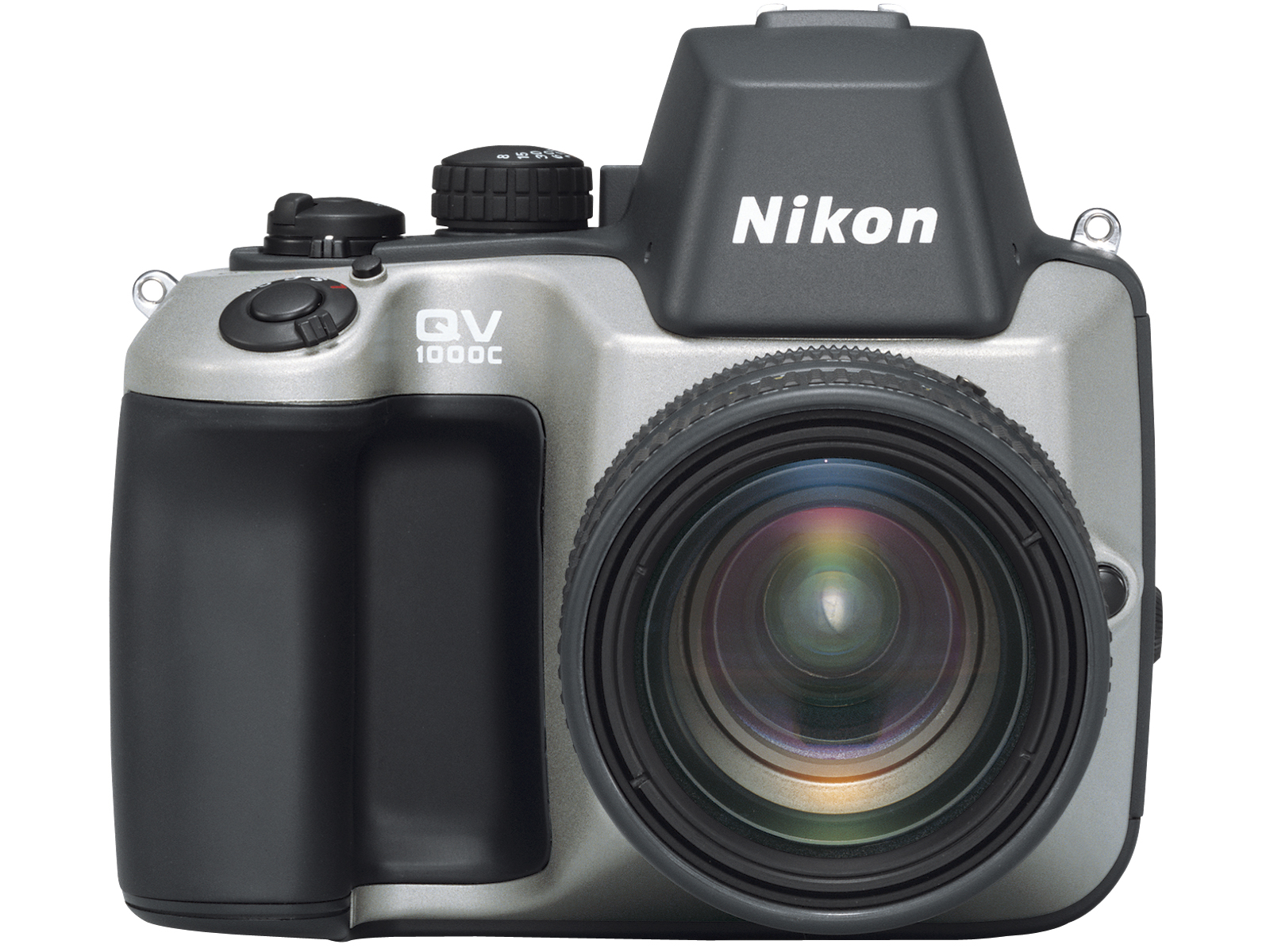
The very first digital SLR prototype (with a 1.6/6 mm. lens), produced by Nikon Corporation, was shown at the 1986 Photokina Exhibition in Germany, followed by a serious ´Still-video´-camera, the Nikon QV 1000C* in 1990. This very expensive - and nowadays rare - camera has a 2/3 inch CCD with maximum resolution of a mere 380,000 pixels and a separate lens mount. At the time of its introduction the camera had the world's highest ISO-setting of 1600 ! It was able to register images at the ESCC-standard in Single mode, Continuous mode ( 4 fps) and CH (20 fps) at 1/1000 sec. when the mirror was locked up. Shutter speed range is 1/8 - 1/2000 sec. Additionally a photo-transmitter (QV-1010T) was supplied. See here for more info about the QV-Nikkors. * QV = quick vision.
Attention!! All Nikon digital SLR´s use either CF, SD and (recently) QXD memory cards. Not all brands will work, so look into the manual of the camera. Format the card - before use - in your camera. The D1-series internal software runs in FAT16-modus; they therefore can´t be used with CF-cards with a maximum memory capacity of more than 2 Gb. All other cameras run in FAT32-modus and will take the ´larger´ cards. IBM-mini drives wont fit all cameras as the card port may be too narrow. Nikon Corporation has made very nice digital reflex cameras - as you will see below - and developed its own Nikon Electronic File (NEF), which is an image capture software for the storage of images in RAW mode. To safe and process these images on a PC or laptop Nikon offers for free software, like Nikon View and Nikon Capture. However, some problems may occur if you are using older Windows OS. Modern QXD-cards need the latest Nikon View software. If you are running e.g. Windows 7 and older the latest Nikon software can't be installed. And you wont be able to open and process NEF-images saved on a QXD-card.. And: All Nikon digital SLR cameras have a built-in auto focus sensor that will work as long as the lens in use (or a lens-teleconverter-combination) has a maximum aperture of f/5.6 or larger (= lower f-number). When using slower (= higher f-number) lenses auto focus may fail. Newer models (2012+) may be used with lenses with a maximum aperture of f/8 or larger. And (2): for resetting your digital camera to factory specifications see here. And (3): All cameras below have a built-in counter of shutter actuations. If you want to know how much shutter actuations the shutter of your camera has made, upload a JPEG-image, made with that particular camera, to https://www.camerashuttercount.com. All cameras will give these data, except the Nikon D1-series and Nikon D100. And (4): For nearly all cameras Nikon issued firmware upgrades. Firmware type C is for camera settings, firmware type A and B are offered separately but should be installed simultaneously. Firmware type L is for upgrading compatibility of lenses and accessories. You may find out here if there is a firmware upgrade for your camera. And (5): To celebrate or commemorate certain achievements Nikon Corporation produced - in a limited number - certain gold-plated cameras. Although these cameras seem to work, only wealthy bling-bling lovers will buy but not use them.
For technical specifications of all Nikon digital reflex cameras visitmatrix (pro-D-SLR)or (semi-pro & amateur D-SLR)matrix Nikon Dxxmatrix Nikon Dxxxmatrix Nikon Dxxxxand/or visit each individual chapter belowsee here which Nikkor lens will fit your Nikon digital reflex camera andfor production data of all Nikon digital SLR cameras look here ;for some digital SLR's Nikon provided LCD monitor coversNikon Df**Nikon D1* - Nikon D2* - Nikon D3** - Nikon D4** - Nikon D5** - Nikon D6**Nikon D40/X* - Nikon D50* - Nikon D60*Nikon D70/S* - Nikon D80* - Nikon D90*Nikon D100* - Nikon D200* - Nikon D300* - Nikon D300S *Nikon D500*Nikon D600** - Nikon D610** - Nikon D700** - Nikon D750** - Nikon D780**Nikon D800/E** - Nikon D810/A** - Nikon D850**Nikon D3000* - Nikon D3100* - Nikon D3200*- Nikon D3300* - Nikon D3400* -Nikon D3500*Nikon D5000* - Nikon D5100* - Nikon D5200* - Nikon D5300*Nikon D5500* - Nikon D5600* - Nikon D7000* - Nikon D7100*Nikon D7200* - Nikon D7500*
* DX-sensor; ** FX-sensor |