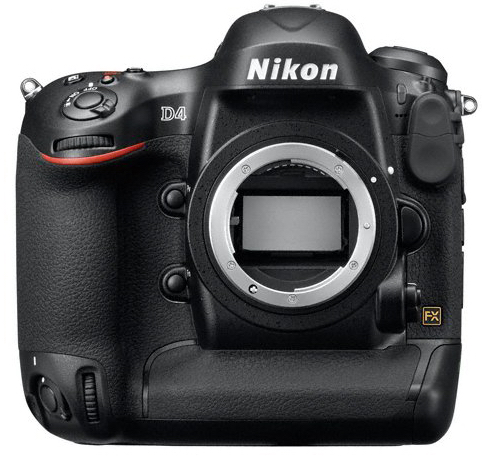
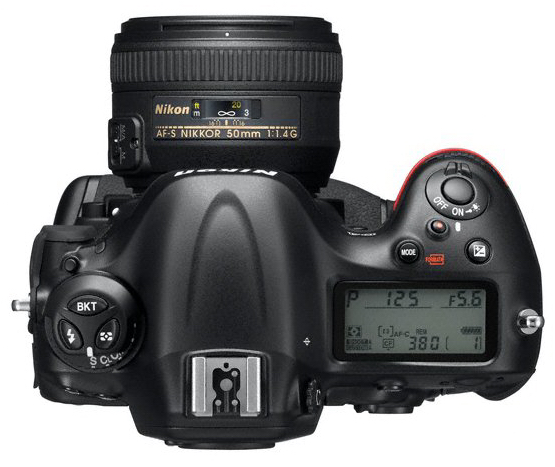
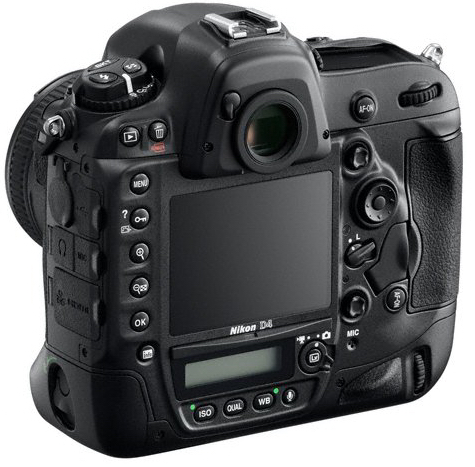
Nikon D4
Those who received a Nikon D3-series digital reflex camera as Xmas 2011 present will look foolish as Nikon Corporation introduced just two weeks later (early January 2012) the Nikon D4. The first (?) of the fourth series of Nikon's digital reflexcameras is packed with the latest features for any professional photographer or movie maker. Nikon's new flagship is equipped with a new Nikon FX-format (aka full frame) CMOS image sensor (imaging size of 36.0 x 23.9 mm) and EXPEED 3, the latest image-processing engine specifically optimized for digital-SLR cameras. The sensor has an effective pixel count of 16.2-million pixels, and 'offers superior image quality under a broad range of lighting conditions with its image sensor supporting an incredible range of sensitivities from (a theoratical) ISO 50 to ISO 204800'.
The layout of the camera body comes close to that of the Nikon D3-series. The new 91K-pixel (approximately 91,000 pixels) RGB sensor supports the Advanced Scene Recognition System, which is able to recognize human faces even when images are framed using the optical viewfinder. In addition, the Advanced Scene Recognition System offers improvements in AF, AE, i-TTL flash control, and auto white balance (AWB) control accuracy. The 51 focus point AF system has been improved with faster initiation of autofocusing and the ability to detect and focus on subjects with less lighting. In addition, 11 focus points are fully functional when lenses with a maximum aperture of f/8 are used. All of this means more precise autofocusing when super-telephoto NIKKOR lenses are used with teleconverters (2.0x). The Multi-area Mode Full HD D-movie movie recording function is capable of recording full-HD movies at 30 fps, and offers three movie recording formats for selection.
The D4 is also equipped with a number of new functions that support a more efficient workflow for professional photographers, including one that allows users to add IPTC (International Press Telecommunications Council) information to images. In addition to built-in wired LAN features, the D4 also supports high-speed image transfer via wireless LAN when the new, compact, easy-to-use Wireless Transmitter WT-5 (sold separately) is connected. For more technical information see the matrix. Nikon Corporation issued a firmware upgrade (1.01) by the end of May 2012. Ask your dealer or local Nikon representation for more details.
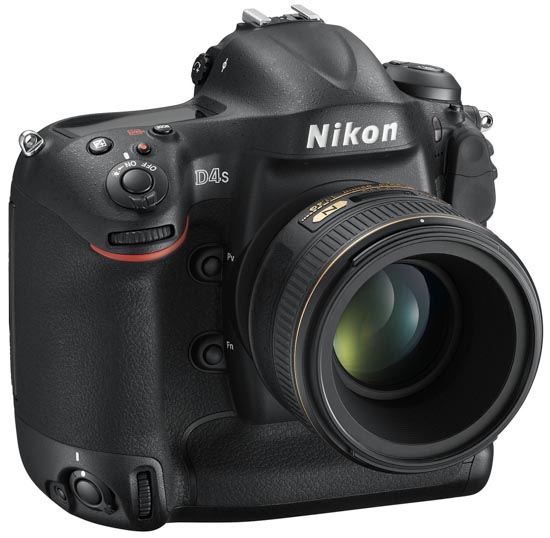
Nikon D4S |