Nikkor autofocus tele zoomlenses
Technical specifications of the lenses listed below can be found here.
AF-Nikkor 4/70-210 mm. In March 1986 Nikon introduced this zoom lens to be used on the first auto focus cameras, like the Nikon F-501. Although its optical performance isn't bad its mechanical construction is not given a long life. Its advantage is the constant aperture at all focal lengths, its disadvantage is the very small manual focusing ring. Luckily Nikon introduced many attractive alternatives.
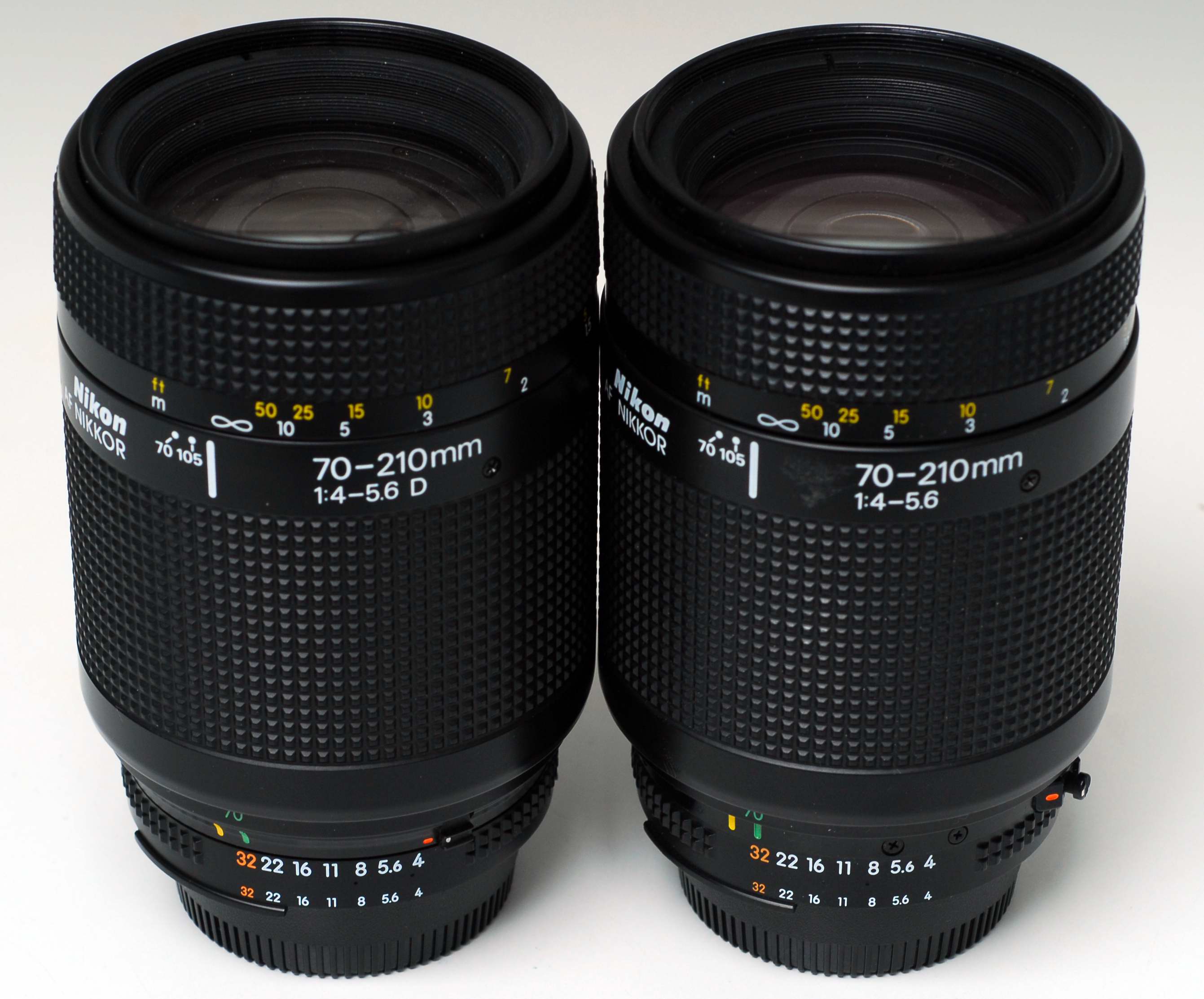
AF-Nikkor 4-5.6/70-210 mm. / D
This is a very nice and rather cheap push-pull zoom lens with very acceptable optical performance. Its first version (above right) was introduced in 1987, the second version (above left) - featuring data transfer - came on the market in 1993. Its easy handling and optical quality made it a very popular lens. The second (D) version has an easier-to-use aperture lock and for flash photography the D-feature is preferable. Both versions have an identical optical construction. The best hood is the HN-24, although when used on DX-digital SLR cameras a longer hood is advisable.
AF-Nikkor 4.5-5.6/75-240 mm. D On paper this lens stands a good change, but in practice this lens is not a shining example of Nikon's optical know how. Stopped down at the shortest focal length its optical performance is OK, but towards the longest focal length quality is decreasing rapidly. Mechanical finish is below Nikon's standards. This lens was introduced in summer 1999 for a relatively low price. It's better to save your money and search for something else in the stables of Nikon.
AF-Nikkor 4.5-5.6/75-300 mm. This rather heavy but strong lens was introduced in 1989. Its body looks like the 4-5.6/70-210 (see above). It is a push-pull lens with tripod collar. Together with a heavy camera the combination give a very stable grip. As with many tele zoom lenses optical performance at its longest focal length is not at the top. The VR-version (see relevant chapter) may make the lens a bit 'faster', but its performance at 300 mm. is disappointing too.
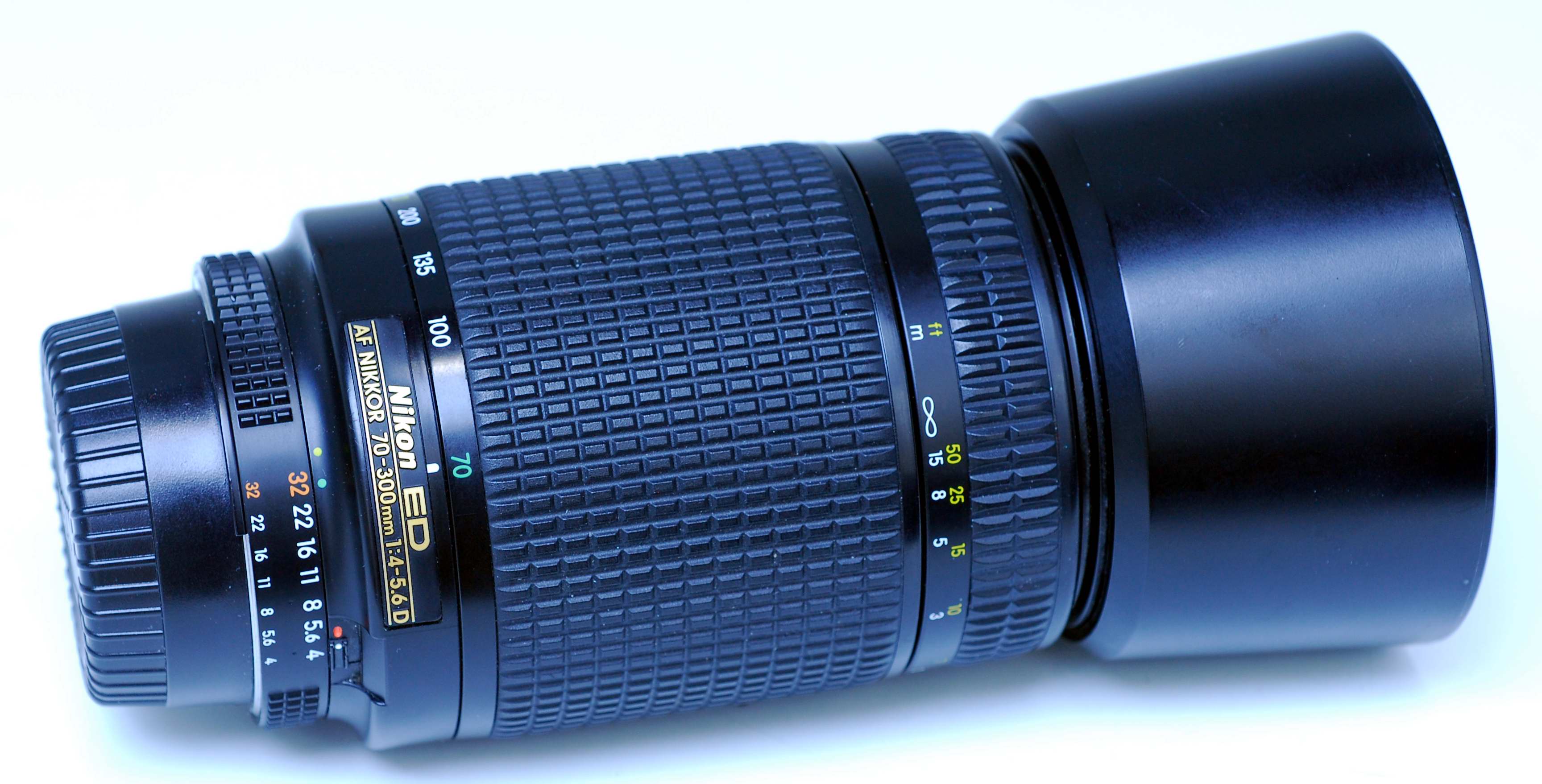
AF-Nikkor 4-5.6/70-300 mm. D ED / G
In 1998 Nikon introduced this lens for the low budget photographers, that were shopping in other brands. The lens is relatively cheap and its performance is - thanks to the ED-elements - very acceptable. In 2000 this lens was replaced by an almost identical lens, but without ED-glass. The G-ring makes it impossible to use it on older SLR cameras. Mid August 2016 a new DX-version of this lens - as AF-P Nikkor - was introduced. It features an new stepping motor for quicker autofocus and fitted 14 elements (of which one is made of ED-glass) in 10 groups, it can be focused down to 1.1 meter and takes 58 mm. filters. HB-77 is the best hood.
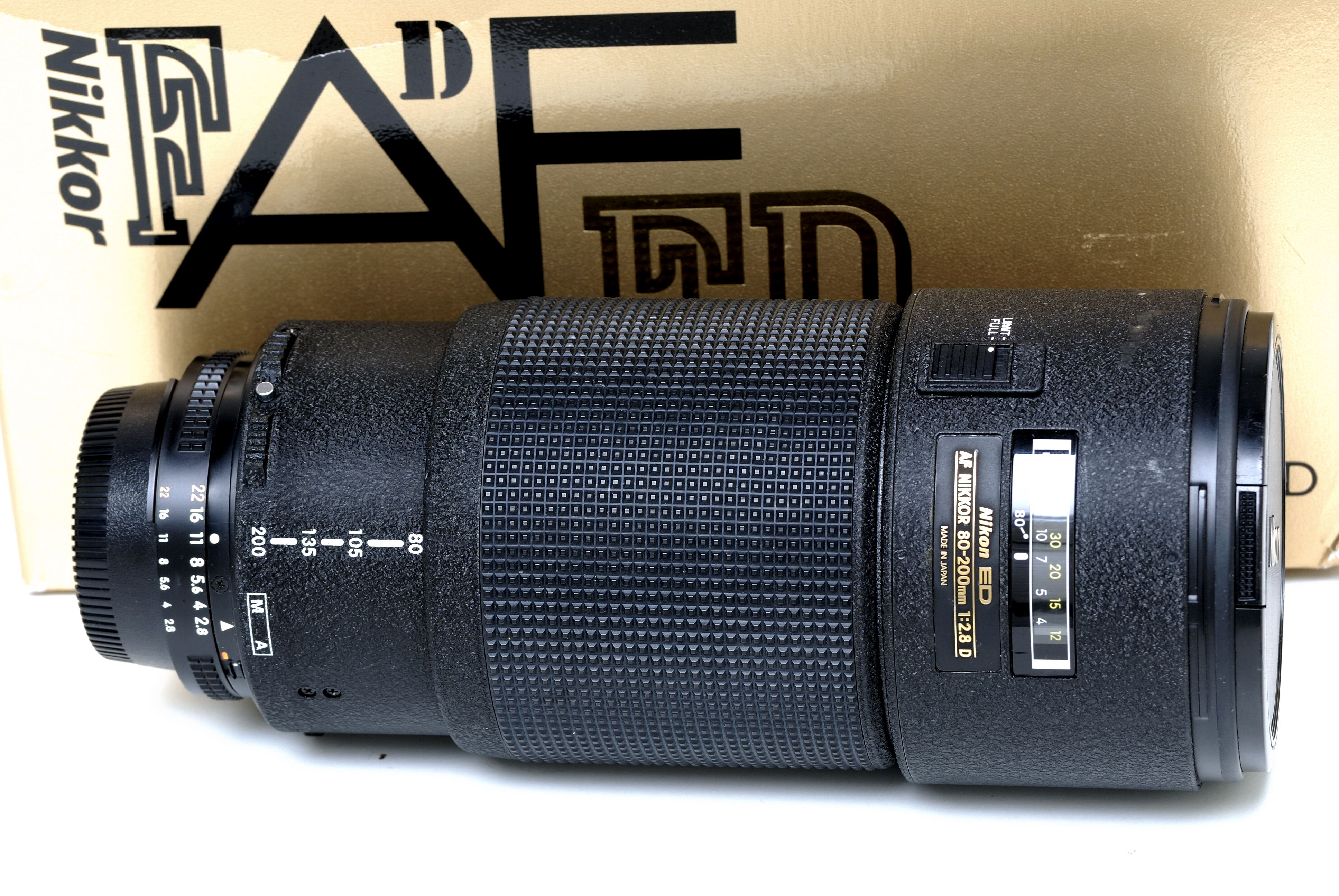
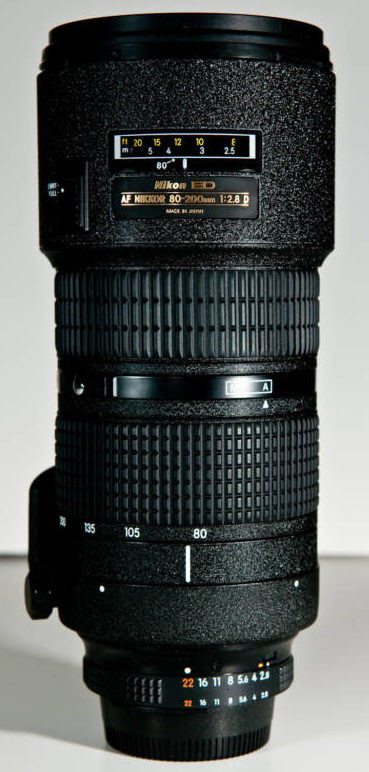
AF-Nikkor 2.8/80-200 mm. ED / D-ED / D IF-ED This popular zoom lens quickly became a legend. Its optical performance is unrivalled. Its mechanical performance, however, is another story. The push-pull versions with their physically rather long zoom range are sensitive to shocks. 'High' cameras (SLR + power pack) may tumble forward and that's not what this lens likes. The first manual zoom lens was introduced at the 1978 Photokina.
The first auto focus version (push-pull) was introduced almost 10 years later. Above the first D-version of this very nice performer.
The best version is the AF-S-version (anno 1998) with two rings (one for zoom and one for focusing) + a tripod collar. This version is - in both focusing and aperture - a fast lens and very suitable to use on a digital (DX) reflex camera. At any aperture and any focal length this lens has an outstanding performance. Even in combination with the various Nikon teleconverters optical quality is superb.
AF-Nikkor 4.5-5.6/80-200 mm. D Another low budget lens to compete with the low-price brands, introduced in 1995. This turning zoom is relatively light (330 gram) and small, but not fast. It takes 52 mm filters and a rubber HR-1 hood. Don't expect optical miracles, but for its price it is a good performer.
|