Nikkorex
Since 1954 Nikon's products were imported in the USA by Joseph Ehrenreich (1907-1973), owner and director of Ehrenreich Photo-Optical Industries (EPOI), New York. EPOI was importer of many other Japanese photographic equipment - like Mamiya and Sankyo - as well. Just after the introduction of the professional Nikon F SLR-camera in 1959, Nikon wanted to become friends with the amateur photographers as well. Ehrenreich suggested to use the name 'Nikkorex' and to introduce a wide range of photographic equipment. As Nikon in Tokyo had limited production facilities Ehrenreich contracted other industries to manufacture his proposed equipment. The cameras mentioned in this chapter were made by Mamiya Inc.; the Nikkorex movie cameras and Nikkorex movie projectors were made by Sankyo Inc., while the Nikkorex slide projector was produced by Sawyer's Inc., Portland, USA. Note: all Nikkorex 35, 35-2 and Zoom35 cameras have a fixed, non-exchangeable lens. Some converter lenses were offered, to be placed in front of the existing lens. See for more details about these lenses this chapter.
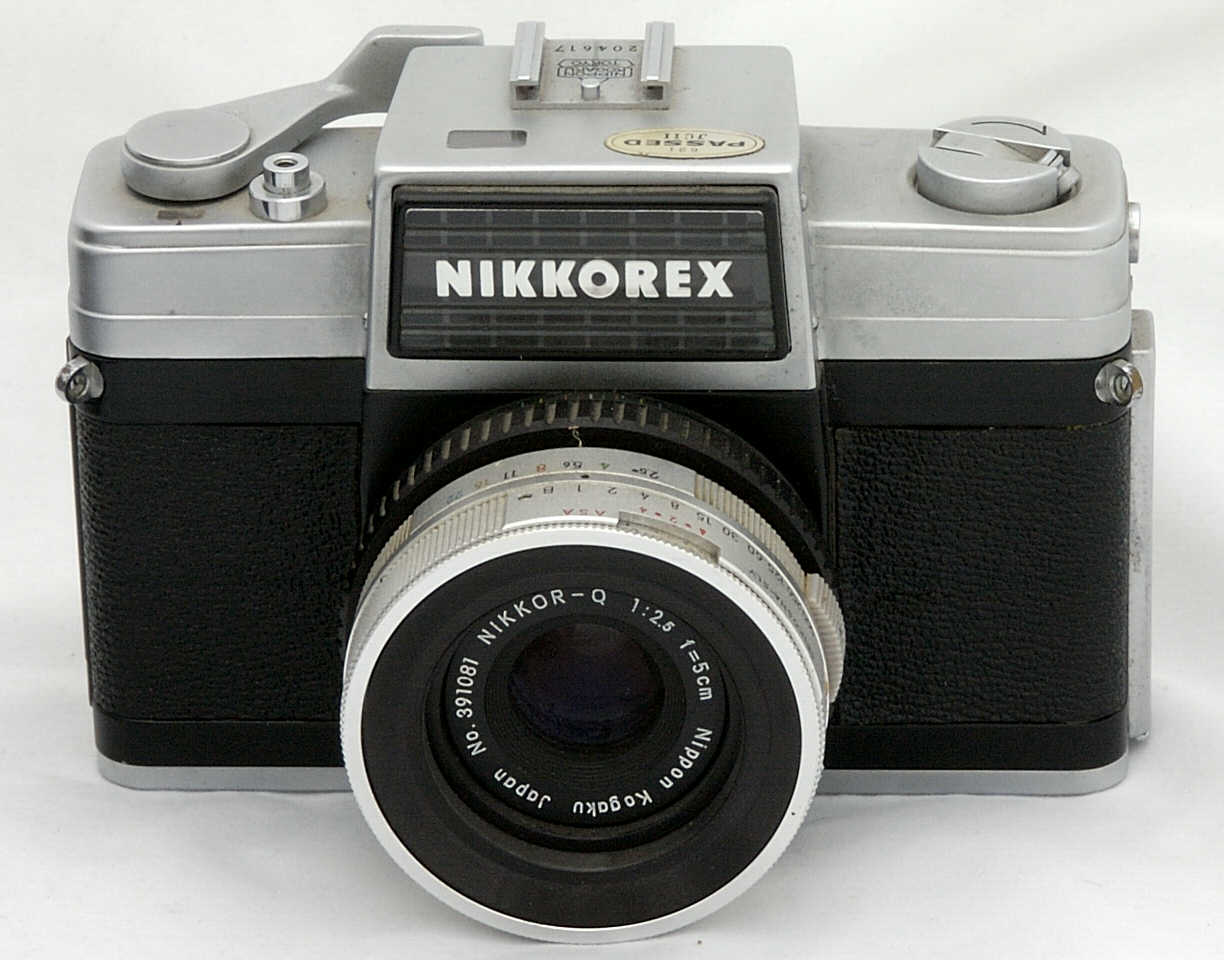
Nikkorex 35 / 35-2
In March 1960 the Nikkorex-35 camera was introduced; a single lens reflex camera, made by Mamiya, with fixed Porro* mirror finder (no prism) and fixed standard lens (Nikkor-Q 2.5/50 mm.). It has a built-in Citizen MVL-central shutter (1 - 1/500 sec.) and a built-in selenium exposure meter. This camera - however - could not compete with many other Japanese cameras. Serial numbers of the first model started at 70001. A second model, the Nikkorex 35-2 introduced in April 1962, received a Seiko-shutter, but kept the same fixed standard lens. Just two months later the Nikkorex F (see below) came on the market. Again two years later, in September 1964, the Nikkorex Auto-35 (aka Nikon Auto-35), fitted with a non-exchangeable Nikkor-H 2/48 mm. wasn´t received with great enthusiasm, either; although this camera had a pentaprism instead of a porro-mirror finder and a quick-return mirror. Serial numbers of this Nikkorex version started at 350001. Nikon also produced extra lens converters (wide-angle and tele) to mount on front of the standard lenses. Interesting feature of the latter camera are the separate (and unequal) serial numbers for both the body and the lens!
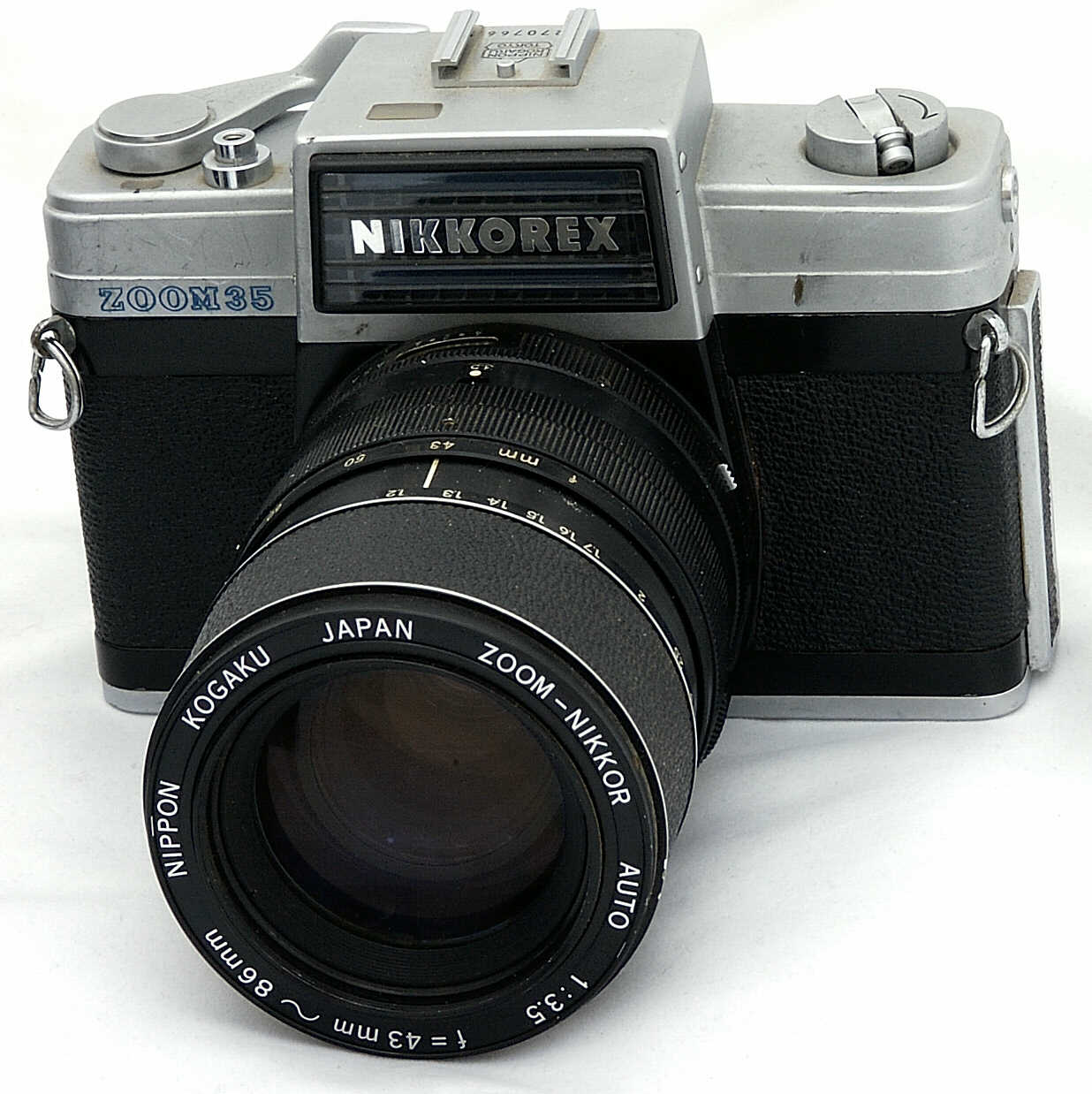
Nikkorex Zoom 35
Nikon tried it again with the production of the Nikkorex Zoom-35, fitted with a Sheikosha-SLV shutter and the well-known Zoom-Nikkor 3.5/43-86 mm. (without serial number!), available from February 1963. In that same period this zoom lens was introduced as the first interchangeable zoom lens for the Nikon F SLR. Serial numbers of the Nikkorex-35 Zoom started at 3500001. The production stopped in 1965. * Porro: named after its inventor Ignatio Porro, an Italian optical engineer. Roof prism or Penta(gon) (= 5 fields) prism is used in most single lens reflex cameras.
Above: all settings should be made via the lens: from left: ASA, aperture, shutter speed, zoom and distance. Nikkorex F
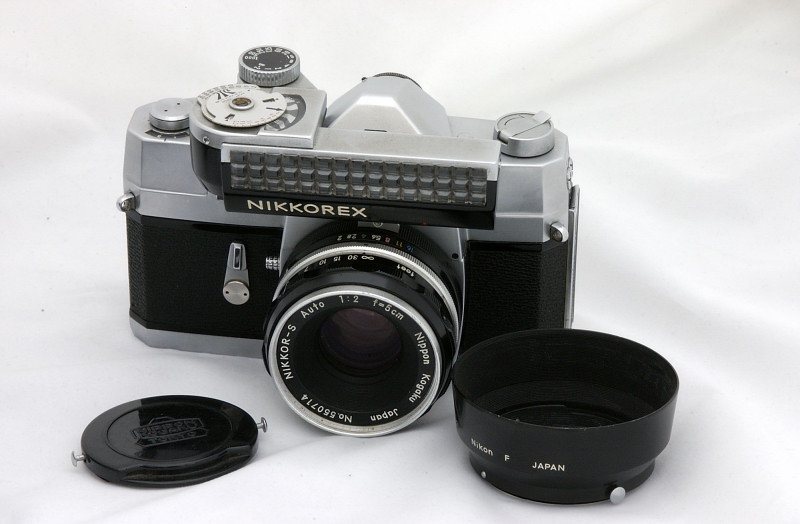
Nikkorex F with clip-on exposure meter and Nikon F lens mount.
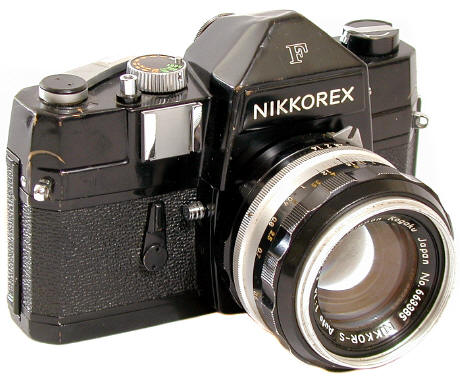
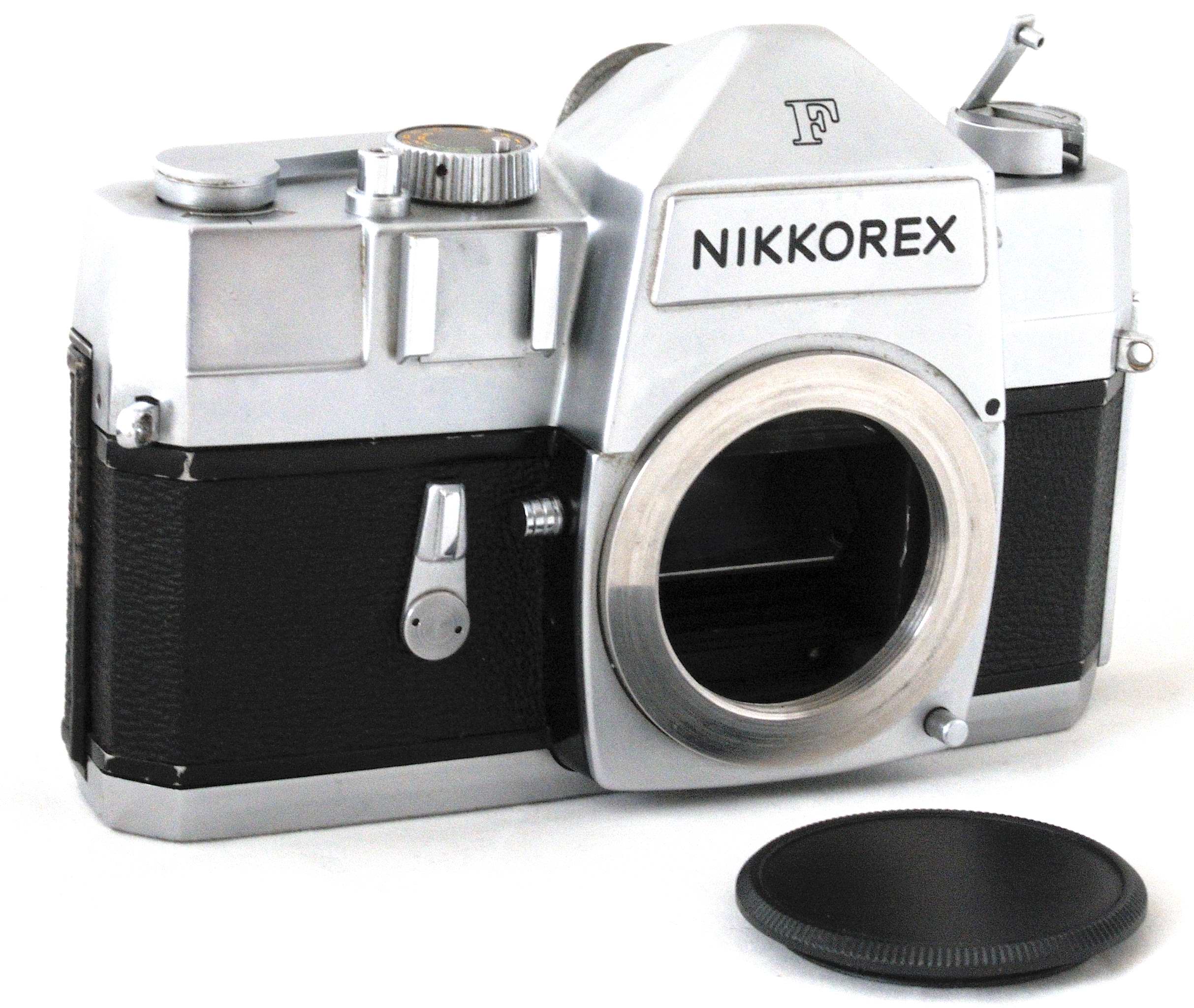
In June 1962 Nikon introduced a more durable Nikkorex F (see picture above) with a newly introduced horizontally traveling Copal Square cloth shutter (see picture below) and the possibility to exchange Nikkor lenses.
Serial numbers of the Nikkorex F started at 350001 and went up as high as 41xxxx. A second, but technically identical version, was introduced halfway 1965. It has partly green shutter indications (1/250 - 1/1000) and no film memory on its back. Unfortunately these series of cameras didn´t became a great success worldwide. Its successor, the Nikomat/Nikkormat series, made this series forgiven and forgotten. Two Nikkorex Sekor lenses were made (by Mamiya) for the Nikkorex F camera, as the real Nikkors might have been too expensive. Both lenses are reviewed here. Identical to the Nikkorex F a Nikkor J was made for the German market. The F on the prism has been replaced by an J.
A rather rare version of the Nikkorex F exists with a M42 thread mount. Serial numbers are in the 37xxxx range. Nowadays it is difficult to find cameras that are still fully operational. Shutters and meters may be dead and the (partly) plastic bodies may have been broken. Nevertheless these cameras are nice for low budget collecting.
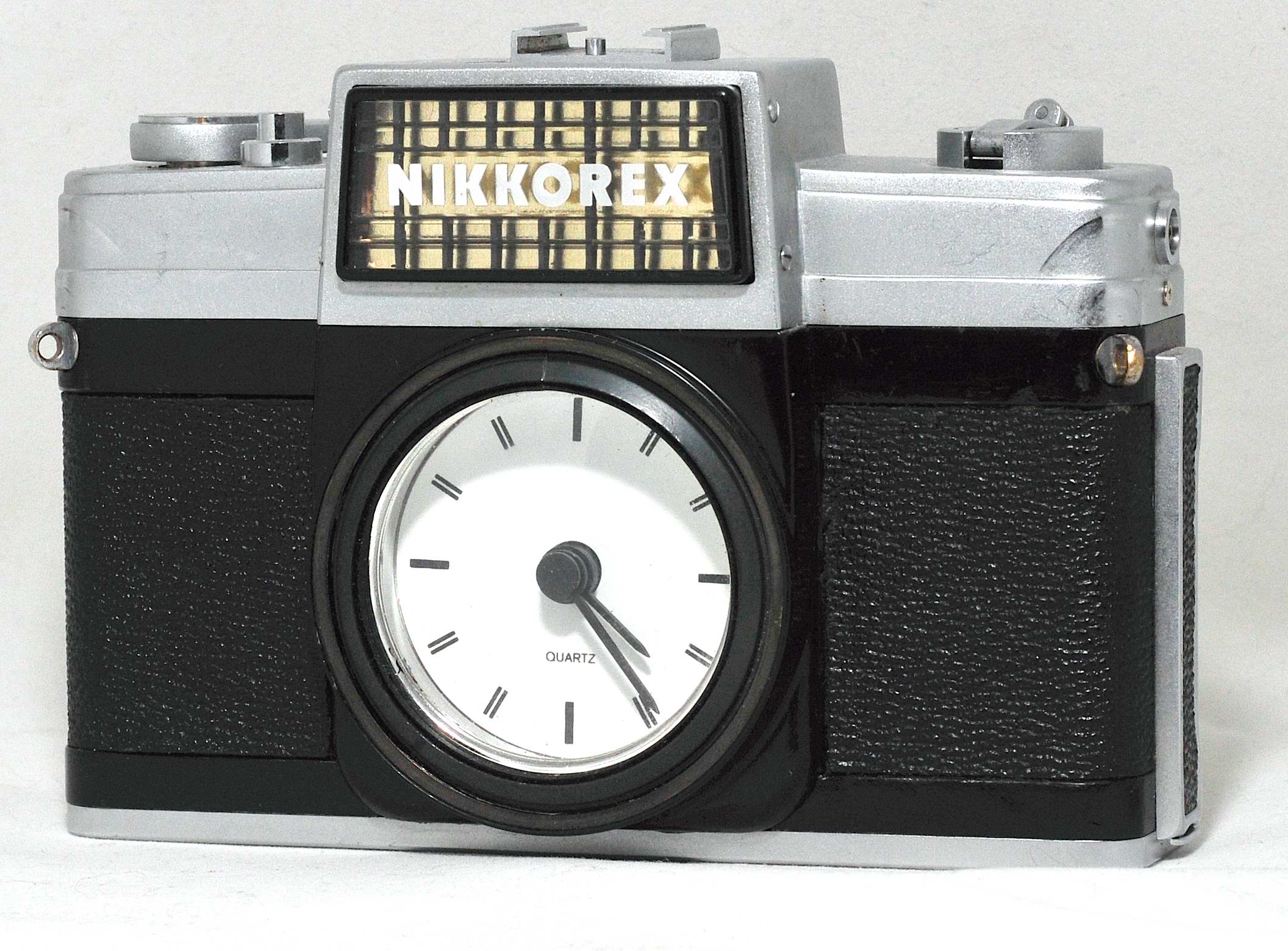
You can always put a clock in it ! :-) After 1966 the production of this unsuccessful camera stopped and the design was sold to Riken Optical Co. which introduced this camera as Ricoh Reflex. Nikon had already introduced the popular and famous Nikomat/Nikkormat series.
|