Nikkor
Mirror lenses
Introduction
Some decades
ago the so called mirror or catadioptric lenses were a hit. Many lens
manufacturers produced mirror lenses in focal lengths from 250 mm. up
to 2000 mm. and more. All these lenses are based on an old invention.
The French
priest and teacher at the famous Pocquet College in Chartres (France),
Laurent Cassegrain (1629-1693) draw and constructed the first hollow/concave
primary mirror, catching light beams which reflected onto a secondary
mirror. This construction didn't produce nice images but made it possible
to construct a relatively short telescope with a - in those years -
large aperture. Cassegrain's design has become the base for nearly all
telescopes in the world. Even today Cassegrain telescopes are used in
astronomy.
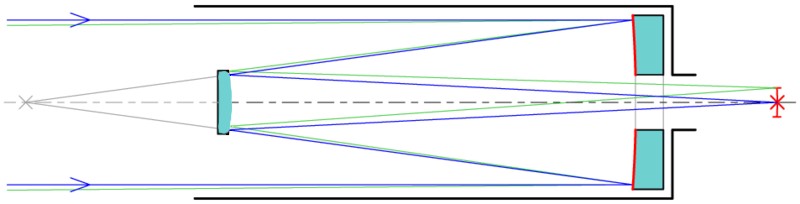
Cassegrain´s design
The German
astronomer Bernard Schmidt (1879-1935) constructed in 1930 an improved
mirror lens with a positive or converging lens (of light beams) in front
of the primary mirror. This construction makes it possible to build
a telescope with a viewing angle of approx. 15 degrees and almost without
spherical aberrations.
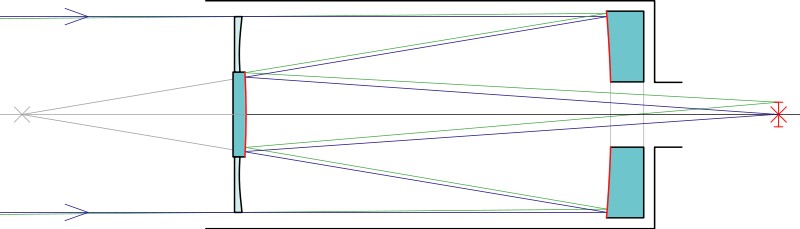
Schmidt´s design
Dr. Dimitrii
Dmitrievich Maksutov (1896-1964) of the St. Petersburg Optical Institute
(Russia) published in the Journal of the Optical Society of America
(Vol. 34, No. 5 - May 1944) a design of a Cassegrain telescope
improved by him. He placed in front of the primary mirror a correction
lens (meniscus) neutralizing many aberrations. The Maksutov-Cassegrain-telescope
was born.
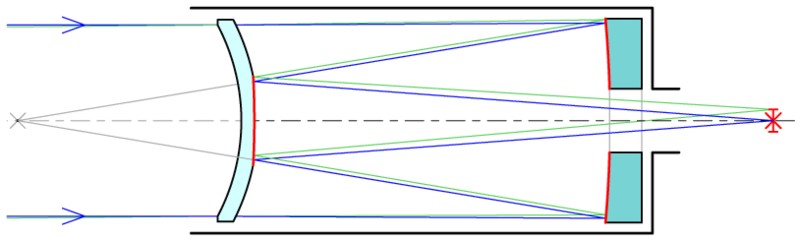
Maksutov´s design
A few years
earlier, however, Dr. Albert Bouwers (1883-1972), a Dutch scientist
and general manager (1941 - 1968) of the 'Olddelft - De Oude Delft'
Optical Industry in Delft, Holland, placed in the light beam two kitten
meniscus lenses of different kinds of glass, but with an identical breaking
index to neutralize colour aberrations.

Bouwers' handheld mirror monocular (Courtesy Louwman
Museum)
He also invented
an anamorphic lens system for wide angle projection, used in Super Technorama-7
film projection. This wide screen projection was first applied in 1959
for the presentation of the Walt Disney cartoon 'Sleeping Beauty'.
The Nikon mirror lenses are in their construction identical. The cylindrical
lens body has in front a large lens with in its center a small dark
plate. In the back of the lens body one can see the primary mirror.
This mirror catches/collects the entering light beams and reflects them
to the secondary mirror behind that small plate in front. This secondary
mirror enlarges the image because of its curvature and passes the light
beam through the central opening in the primary mirror via a group of
enlarging lenses to the film plane. These rear lenses are defining the
focal length of the entire mirror lens. This whole construction makes
it possible to produce a relatively short lens with a long focal length.
To produce a fast mirror lens a large front lens and large primary mirror
is necessary. That's why the Nikkor 6.3/100 cm. and the Nikkor 11/2000
mm. are huge 'barrels'.
Many mirror
lens producers may say that it is an easy handling lens which enables
you to make handheld pictures. Well, forget it!! A mirror lens with
a focal length of 250 mm. might work, but lenses of longer focal lengths
are very difficult to hold.
Because of
the small aperture (5 - 11) and heavy weight (up to 10 kilo) a tripod
is indispensable. Than there is the relatively long minimum distance
(up to 30 meter!) and the little depth of field. A nice or disturbing
effect of mirror lenses are the rings (aka donuts) in the unsharp parts
of the images. Some mirror lenses also have a so called hot spot in
the center of the image, caused by a small secondary mirror. An important
advantage - however - of a mirror lens is the absence of chromatic aberrations.
Spherical aberrations may be eight times less than in a lens construction
with an equal aperture and there is no light absorption. Finally, when
using infrared films focus adjustments are not necessary.

Image made with Reflex-Nikkor 8/500mm. + Nikon D1X at
high ISO.
Buying a
second hand mirror lens does need attention. Inspect all mirrors thoroughly
(no fungus, moisture, etc.) and the front and rear lens. A mirror lens
with a 'squint' is difficult to adjust. Never open a mirror lens as
adjusting a mirror special tools are needed.
Note:
All mirror lenses with a Nikon F-mount listed below may fit nearly all
Nikon SLR cameras ever produced; even the modern digital SLR's. The
older mirror lenses do not have an AI/S or electronic coupling mechanism,
but the mount is spacious enough without hitting electronic contacts
etc.
Let's have a look at the Nikon mirror lenses. A matrix of all Nikon
mirror lenses can be found here.
Reflex-Nikkors
All Nikon
mirror lenses, presented below, are based on the Maksutov-Cassegrain
principle. They may be used with Nikon tele-converters (TC-200, TC-201,
TC-301, TC-14 and TC-14A), but it is advisable not
to do so. Focusing is hardly possible and image quality is bad.
Reflex-Nikkor
5/50 cm.
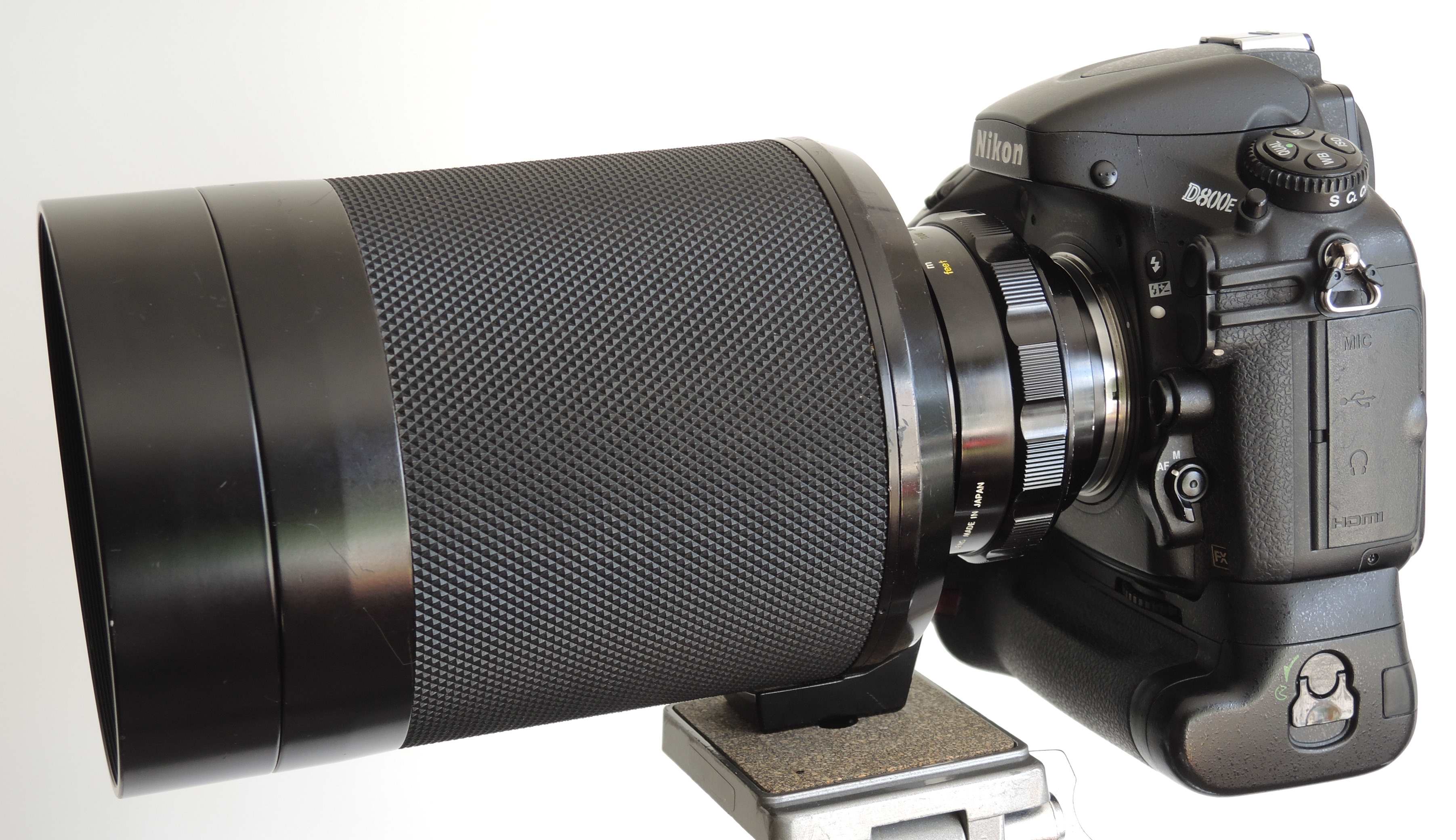
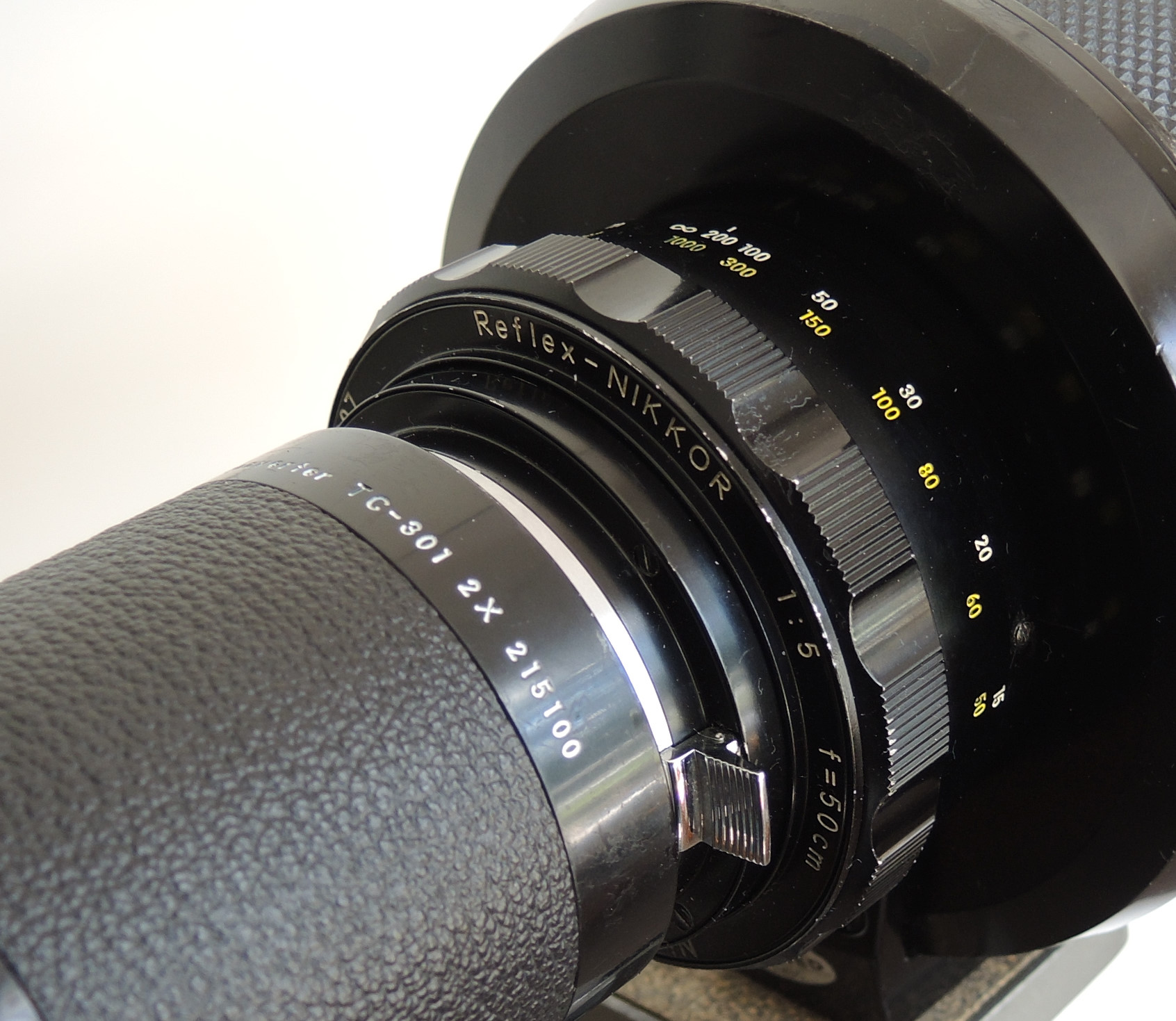
Reflex-Nikkor 5/50 cm. mounted on a Nikon D800E
Presented in August 1961 this lens was rather fast with a fixed aperture
of f/5. At the front 122 mm. filters can be used, but at the rear end
smaller (thus cheaper) 39 mm. filters can be fitted. That filter should
stay there as it is part of the optical formula. The mirror lens has
a scalloped focusing barrel in between the lens barrel and lens mount.
Lens specifications are engraved in the focusing ring. This black lens,
weighing in at 1.7 kilo, has been produced 9 years with an estimated
production of some 3,000 lenses. Optical performance is not bad at all,
given its age.
It is possible to mount a Nikon teleconverter on a mirror
lens (if you remove the rear filter), but focusing is very difficult
and image quality is not very good. See image below.
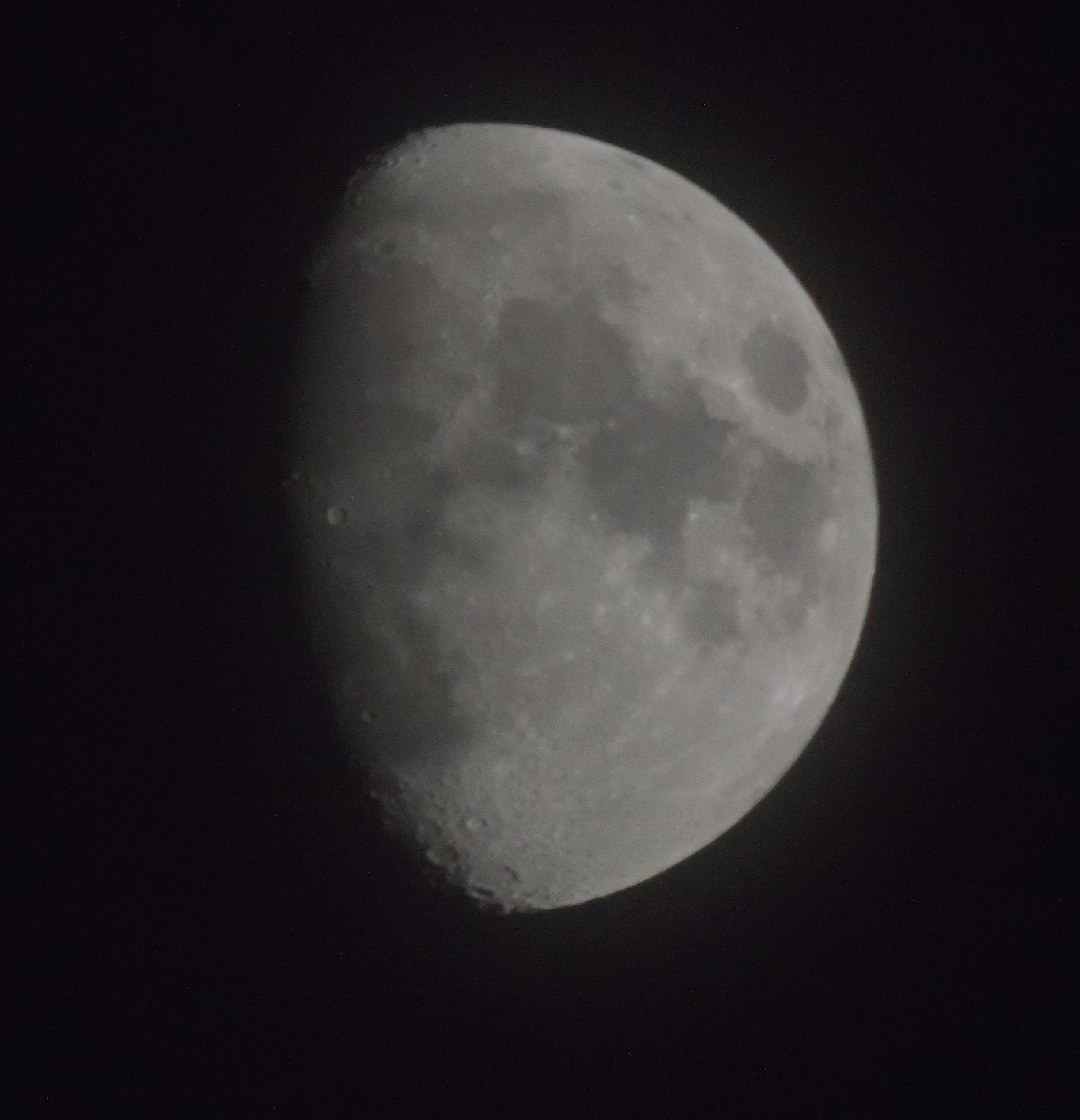
Nikon D810 + Reflex-Nikkor 5/50 cm + TC-301 @ ISO 6400.
Reflex-Nikkor 8/500mm.
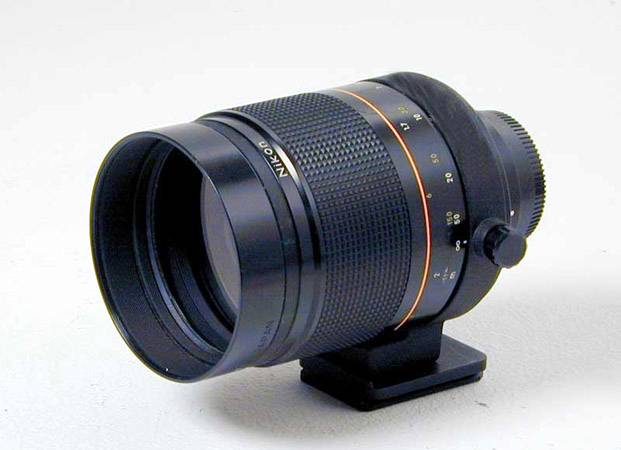
This lens
was presented at the 1968 Photokina Camera Fair in Cologne (Germany).
It has no separate focusing ring but the whole barrel should be turned.
At the rear filters (39 mm.) can be fitted. In fact the filter is a
part of the optical system. If a teleconverter is used that filter should
be removed. In 1974 an improved (= better coated) lens was introduced,
bearing the name Reflex-Nikkor-C. Both versions have a minimum focusing
distance of 4 meter and weighing in at about 1 kilo. A redesigned version
of this lens was introduced in 1984. Minimum focusing distance is 1.5
meter and its weight is 840 gram. Important is the much better performance:
no hot spot, very nice equal light distribution and no internal reflection
due to improved coating. Of all versions approx. 60,000 lenses were
produced.
Reflex-Nikkor 6.3/1000mm.
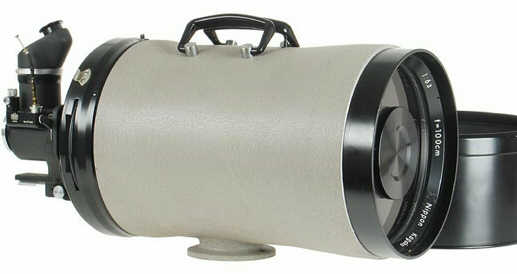
Rare 100 cm Reflex-Nikkor with reflex housing for rangefinder
camera
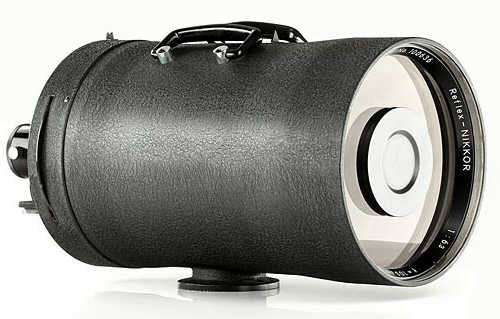
Only a few 100 cm Reflex-Nikkors were available in black
Almost 10
kilo for a lens is quite a load. This heavy barrel was shown to the
press in June 1959. A few months later is was taken into production.
In front a 224mm. (!) filter can be placed; better is to use 52 mm.
filters in the turret near the mount. On top of the barrel are two handles/grips,
at the bottom a massive tripod plate is mounted, enabling to turn the
lens barrel 90 degrees. Focusing, via a bellows (like the Zeiss Mirotar),
runs from infinity to a 'minimum' of 30 meters! This rare lens was available
with a lens mount to fit Nikon rangefinder cameras (S-mount), to fit
the Nikon SLR's (F-mount) and to fit Bronica cameras. Total production
is estimated at a mere 100 lenses.
Reflex-Mirror 11/1000mm.
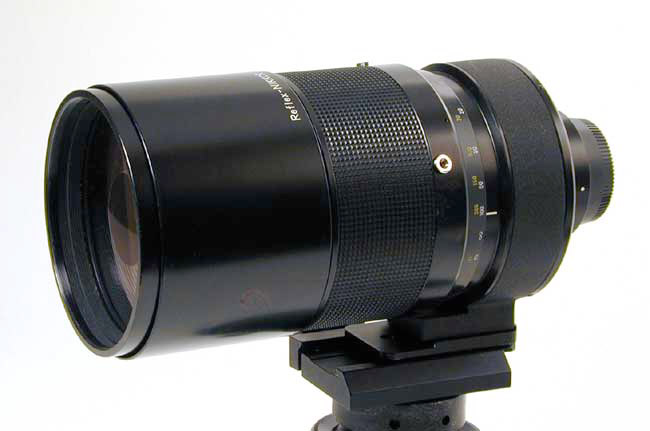
A prototype of this lens was presented in October 1965. The front lens
has a filter thread of 108 mm., but at the back 4 filters (L39, Y48,
O56, R60) are built-in (like a revolver magazine). This lens weighs
in at 2 kilo. In 1974 a second version, without a filter revolver, was
introduced, followed by a redesigned version two years later. The barrel
now has a tripod ring and a stylus/pin can be fitted in the barrel making
focusing a bit easier. Total production some 16,000 lenses.
Reflex-Mirror 11/2000mm.
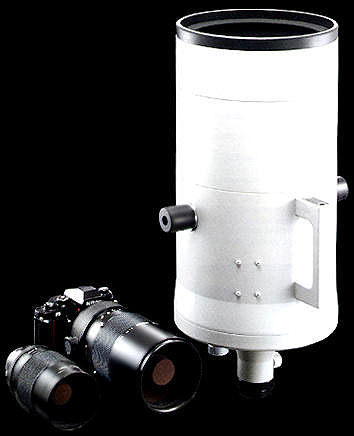
From left:
Reflex-Nikkor 8/500mm. - 11/1000mm. - 11/2000mm.
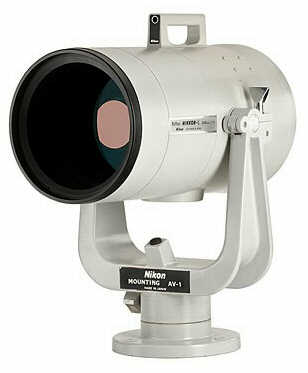
This rather
fast but huge 'beer barrel' of 17.5 kilo was shown at the 1970 Photokina
Camera Fair in Germany. The minimum focusing distance is 20 meters and
at the back 62 mm. filters can be fitted. In 1975 an improved version
was introduced. It has a better coating and the hot spot disappeared.
This colossus has to be mounted on a U-shaped tripod holder, which weighs
in at 7.5 kilo, bringing the total weight at a heavy 25 kilo! Some 350
lenses were made.
Who claims
that handheld photography is possible with a mirror lens?!
Back to top
|