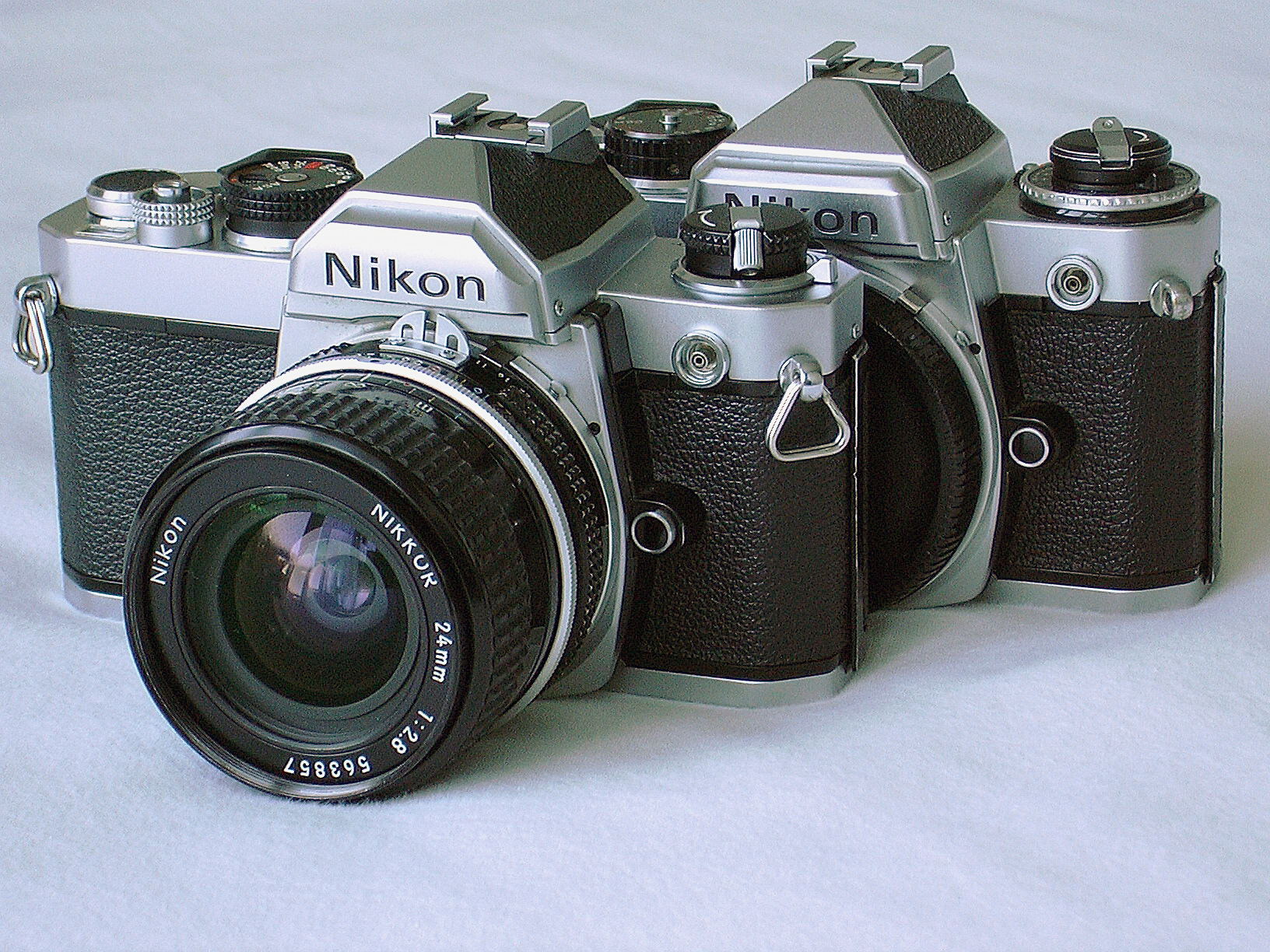
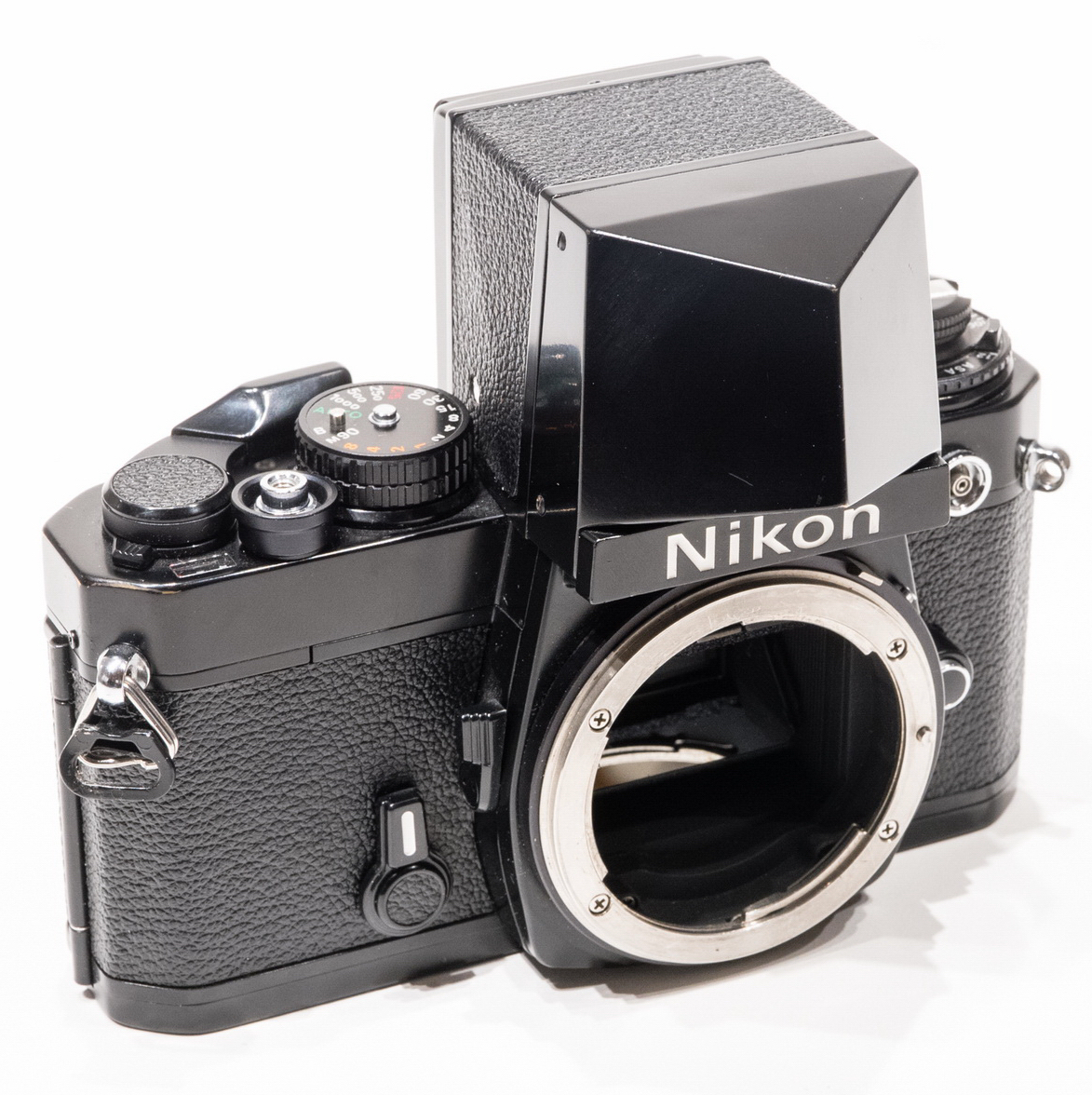
Nikon FM/FE/FA(main technical specifications of all cameras in this chapter in a matrix) Mid 1977 Nikon introduced the successor of the Nikomat/Nikkormat series: the first Nikon compact reflex camera, the Nikon FM. It is a full mechanical, all metal single lens reflex camera with fixed prism, but with built-in exposure meter, shutter speeds from 1 - 1/1000 sec. + flash sync. of 1/125 sec. The shutter is the newly developed Copal CCS-M shutter. The bayonet mount has the new locking tab for the AI-lenses, but it can be lifted for the use of all earlier lenses, except some fisheye-lenses, as the mirror can´t be locked up. This camera is still a ´wanted´ camera, because of its durability and versatility. Serial numbers of the Nikon FM started at 2100001. One year later (April 1978) an automatic version was presented, the Nikon FE. This camera has the same features plus an aperture-priority program. The electronic shutter runs from 8 - 1/1000 sec. The very first version of the FM differs a bit from later versions and the FE: the ribbed collar around the shutter release button can be rotated to lock the shutter. Later versions have a plane collar; when the film advance lever is in its closed position the shutter is locked. Serial numbers of the Nikon FE started at 3000001.
Mechanical Nikon FM (in front) and electronic Nikon FE
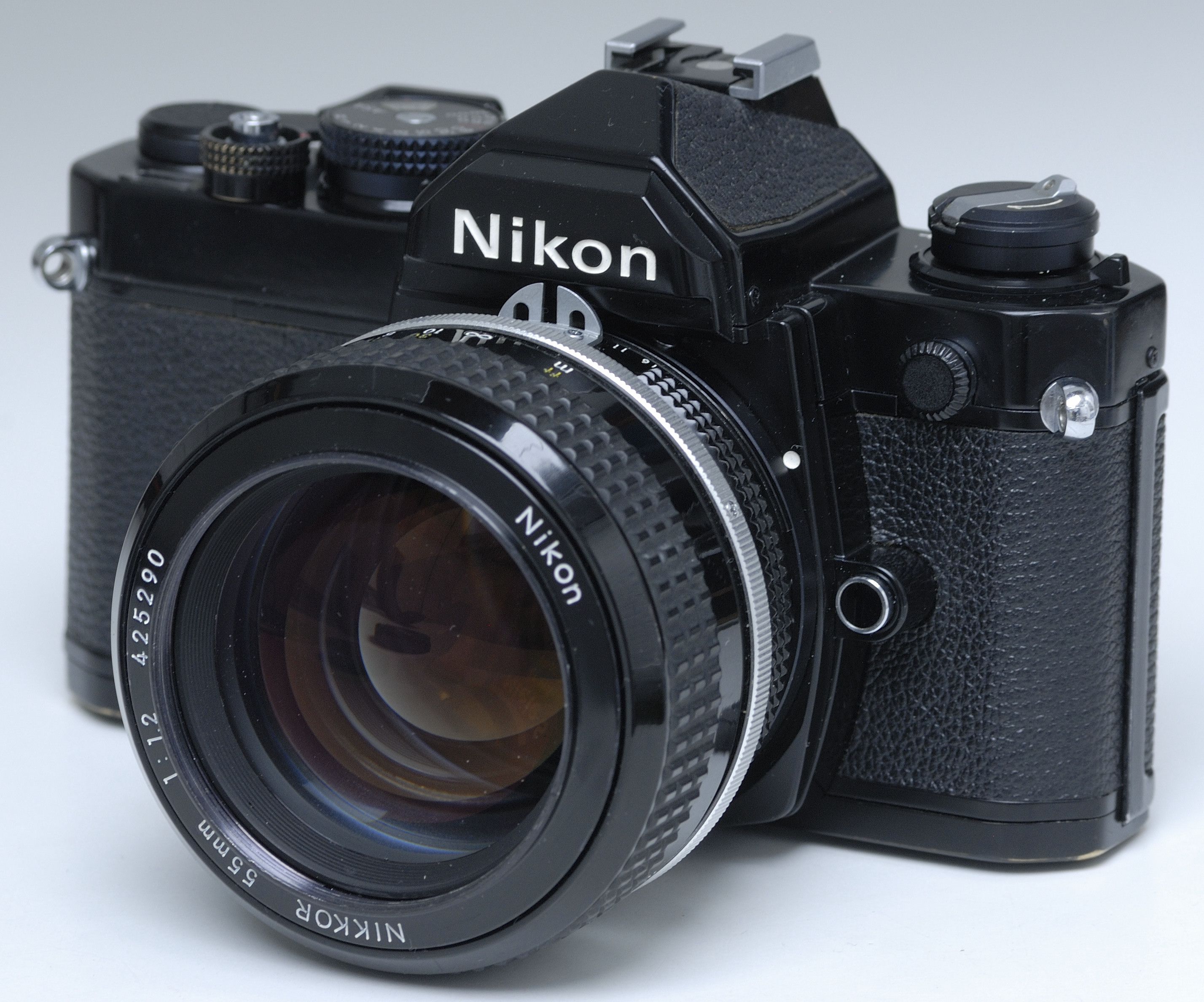
Black Nikon FM (first version) with contemporary Nikkor 1.2/55 mm.
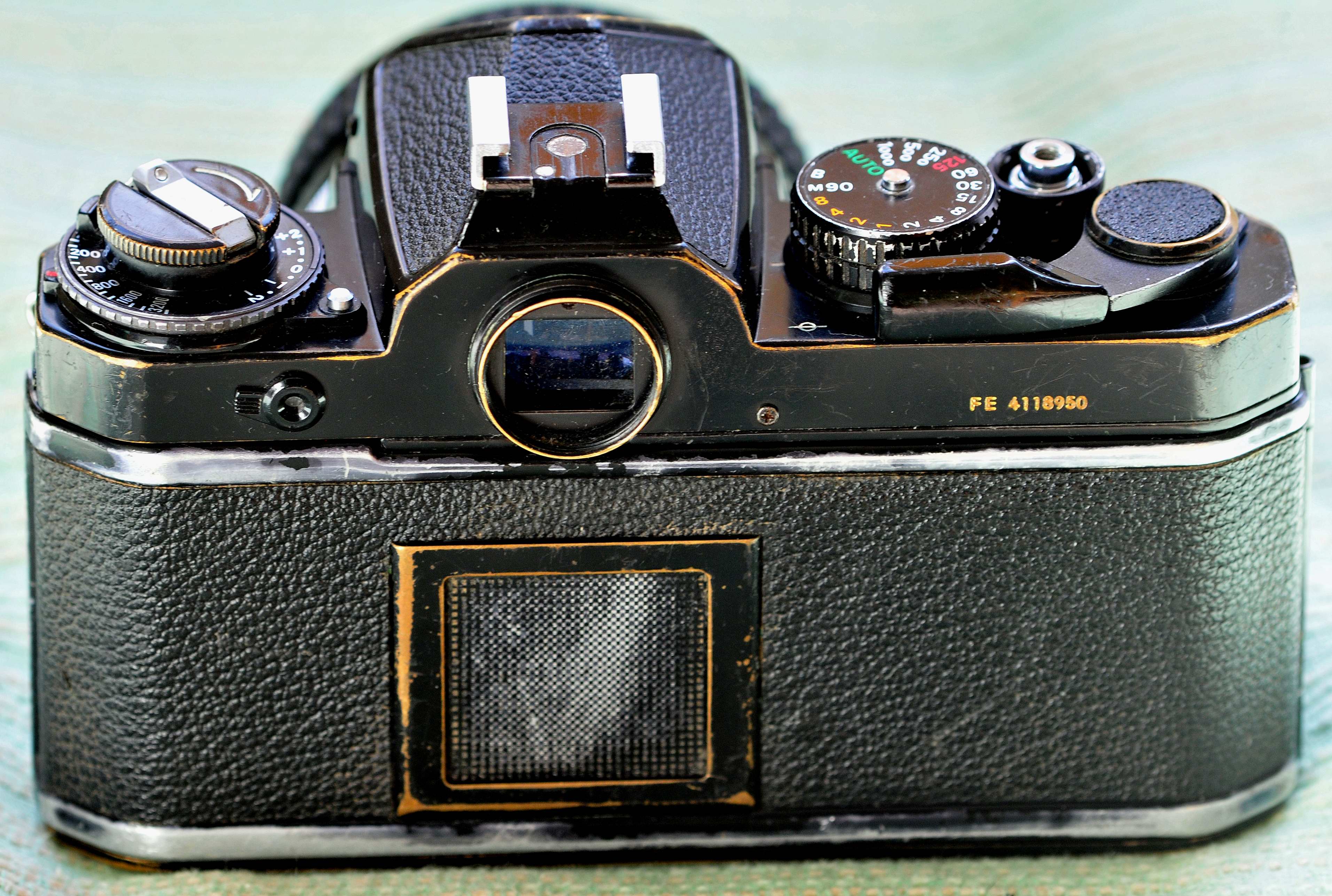
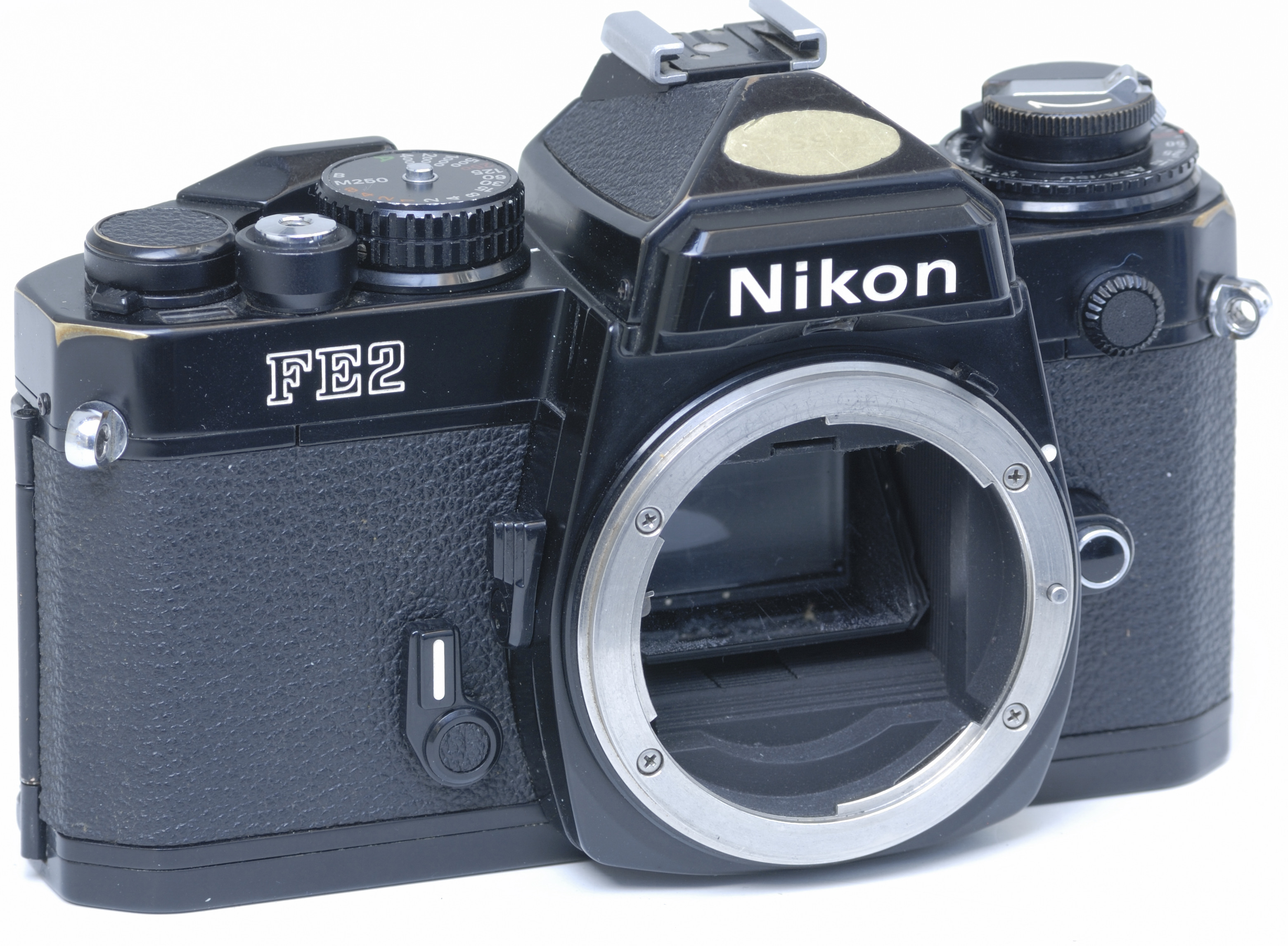
The back of a heavily used Nikon FE explains the different metals that were used. Left on top the ISO selector and exposure compensation selector. Below these selectors the battery check. At right on top the shutter speed selector with M90 and B as the only mechanical speeds. All other speeds need electric power. On the right side of the film winding lever the double exposure button. The success of both cameras made Nikon Corporation to improve both cameras and to introduce a more sophisticated version in March 1982: the award winning Nikon FM2, followed one year later with its electronic sister, the Nikon FE2 (see below). Serial numbers of the Nikon FM2 started at 7000001, the Nikon FE2 started at 2000001.
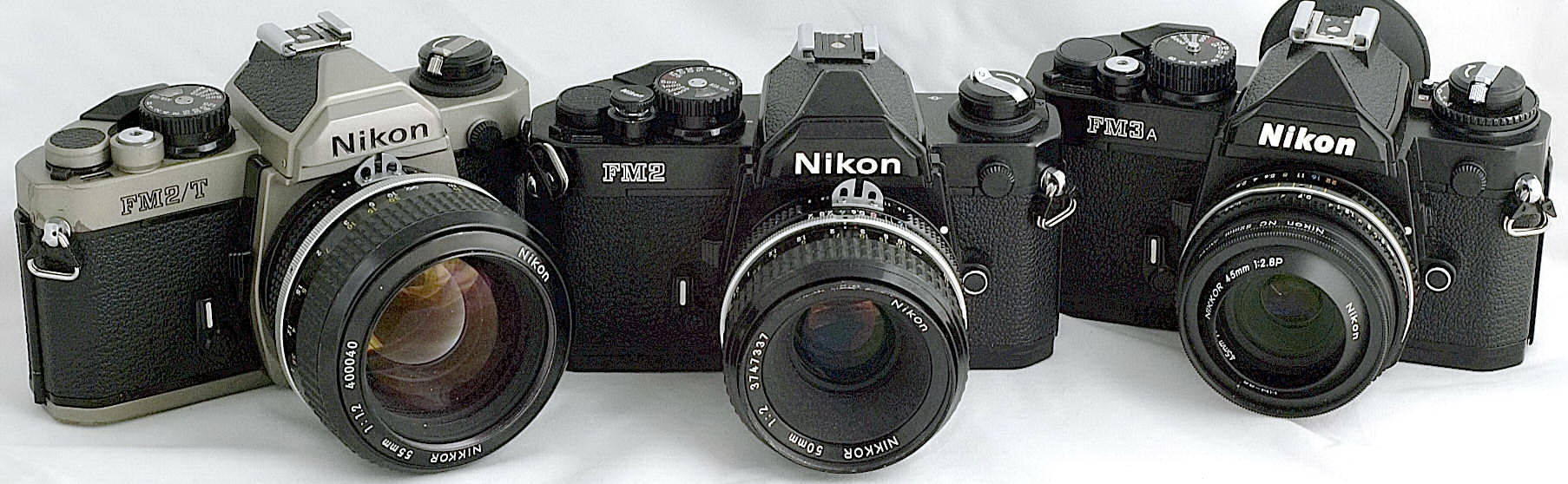
Both cameras have a very fast shutter, running from 1 - 1/4000 sec. In those days a world record! In fact Nikon engineers were trying to increase the flash sync of the camera, which they did (1/200 sec., later 1/250 sec.); as a coincidence the top speed was increased as well.! The Nikon FM2 received some modifications in March 1984; known as the New Nikon FM-2 or Nikon FM-2n. The flash sync (1/250 sec. in red on the dial) was increased and the serial number was preceded by an N. In October 1989 the Nikon FM-2 received aluminum shutter curtains. The FM2 has got another sister in December 1993: the Nikon FM2/T. A ´normal´ FM2 but with its top and bottom made of a titanium alloy. Many publicists make us believe that the camera back is made of titanium as well, but that´s not true.
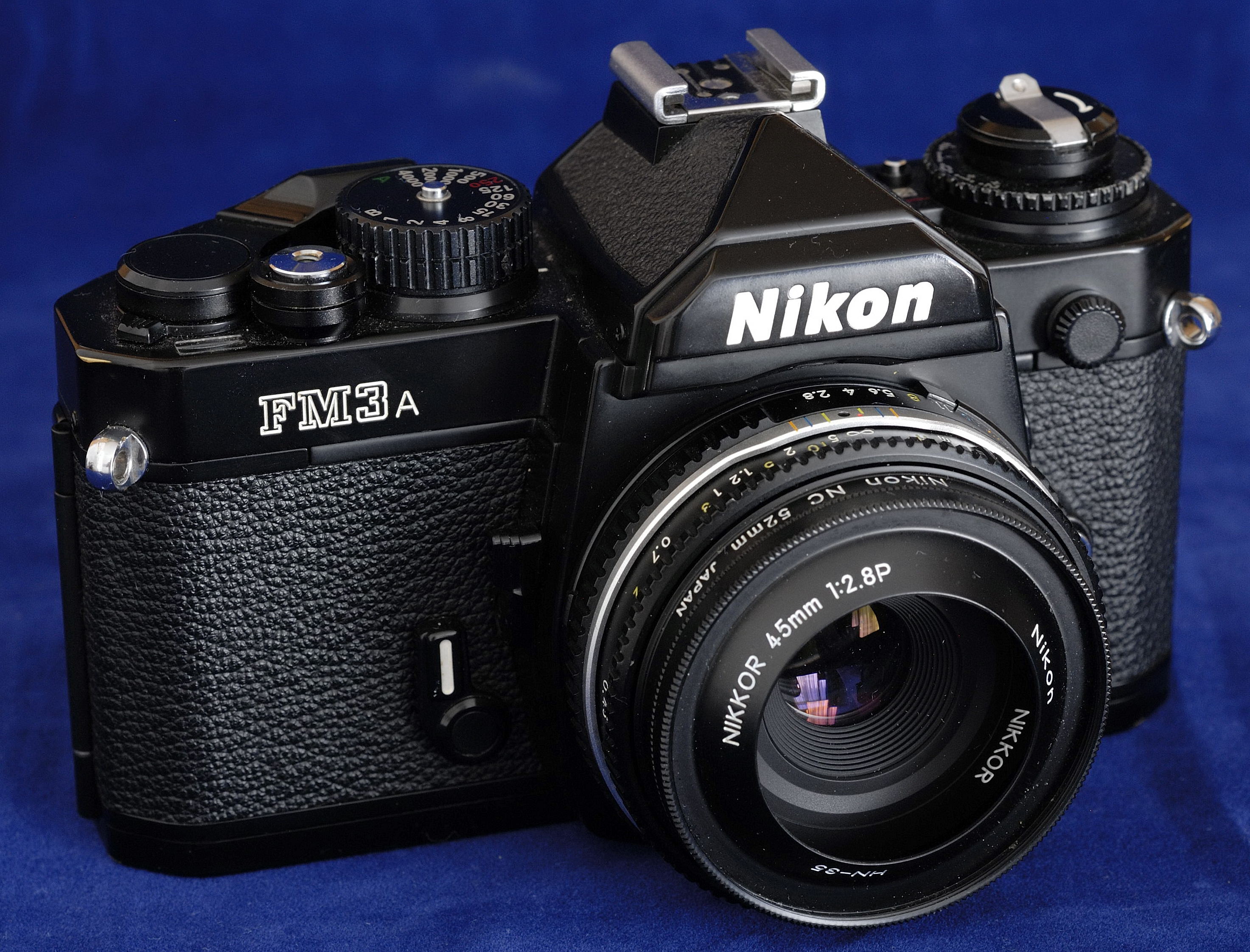
Early this century, after nearly 20 years of production, the Nikon FM2 (and the FE2) was succeeded in July 2001 by a (technically) combination of the Nikon FM2 and Nikon FE2, the Nikon FM3a. This camera has all features of the Nikon FM2 + FE2. It has a hybrid shutter: mechanical speeds from 8 - 1/4000 sec., but if set on 'A' it becomes a electronic camera with aperture priority program. It is a pity that Nikon didn´t give the Nikon FM2/FE2/FM3a the folding AI-locking tab. This would have made these cameras the most versatile Nikon cameras ever.
From left: Nikon FM2/T, Nikon FM2 & Nikon FM3a All cameras could be ordered in a chrome or black outfit. And all cameras can be fitted with either the MD-11 or MD-12 motor drive, giving them a top speed of 3.5 fps. The MD-12 is to be preferred as the MD-11 runs down the battery in the camera when the on/off switch of the motor drive isn´t set to ´off´. The exposure meter in the camera is fed by that small battery in the bottom of each camera. The batteries in the motor drives do not feed the exposure meter! Note: When using a MD-11 or MD-12 with a Nikon FM the ring around the shutter release button of the camera should be placed at the red mark. The Nikon FM and Nikon FE may be used with a data back: Nikon MF-12, the Nikon FM2/FE2/FM3a/FA takes the Nikon MF-16.
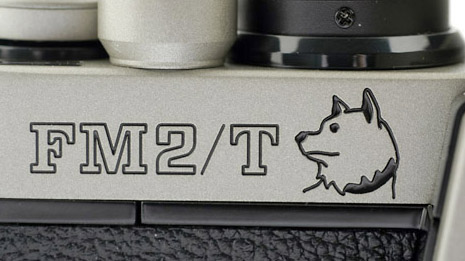
Nikon Corporation made several commemorative cameras like the Nikon FA Gold, Nikon F5 Anniversary etc. In 1994 a limited number of Nikon FM/T Year of the Dog cameras were marketed. They are identical to the regular Nikon FM/T save the engraving on the front of the head of a Japanese Chen-ten dog. Serial numbers are known from 9400001 - 9400300.
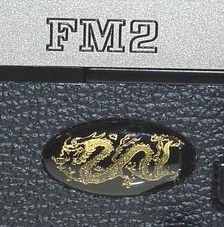
In the year 2000, which was the Chinese Year of the Dragon Nikon produced a limited series of 2000 (regular) Nikon FM2 with a symbol on its front. Each camera came with a (regular) Nikkor 1.4/50 mm. having the same serial number (xxxx/2000) as the camera body.
A (nowadays very rare) Nikon FEA was made during the late 1970's for National Geographic's photographers. It has a non-exchangeable sports finder for better viewing when wearing a helmet etc. Less than a hundred were made and thus sought after. On the back FEA + serial number (#5xxxxx) is engraved.
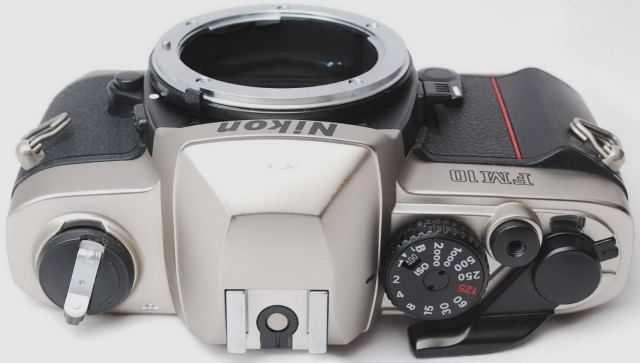
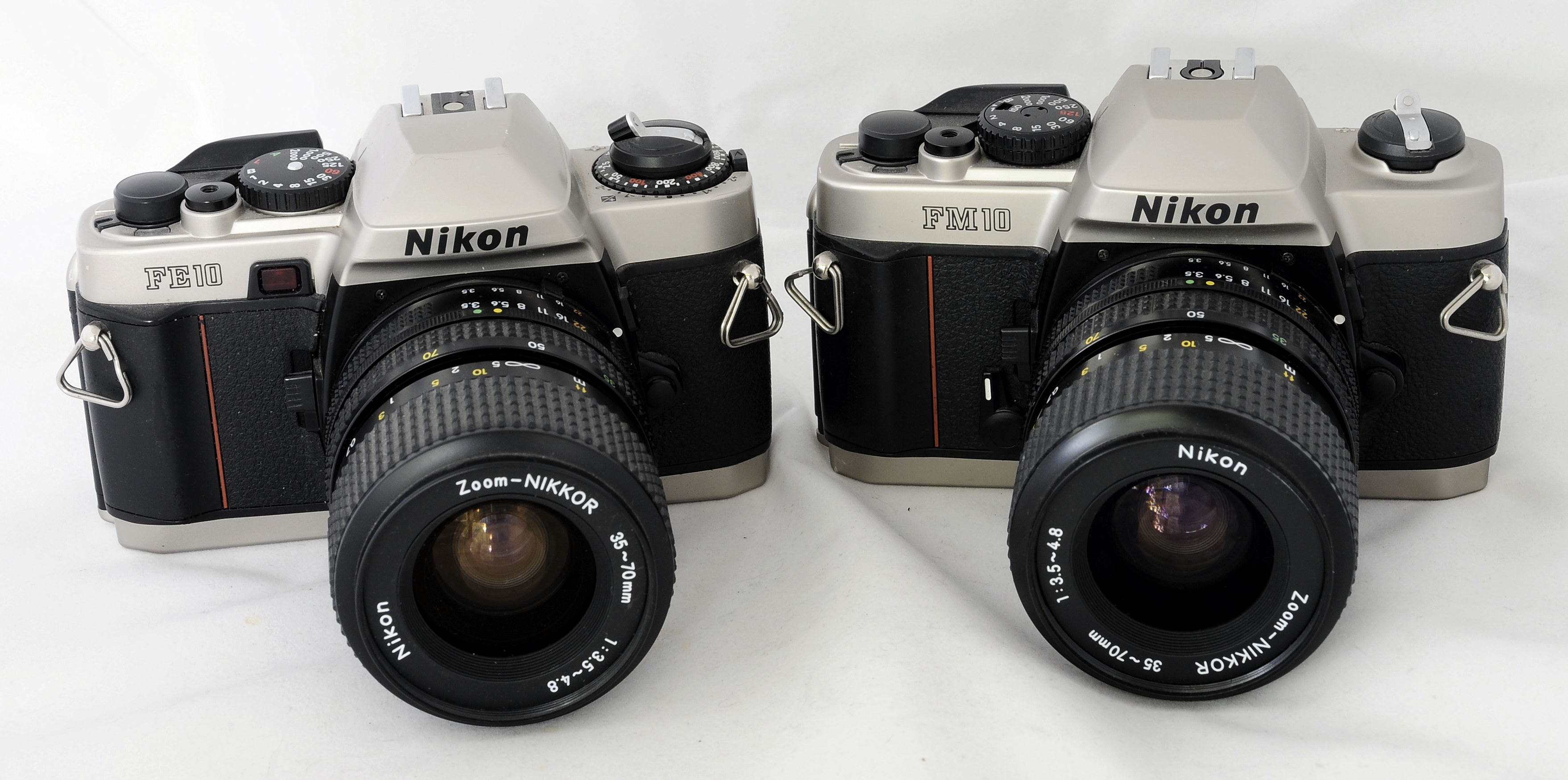
Nikon FM10 / FE10
Many Nikon FM/FE/2 users became enthusiast when Nikon announced the Nikon FM10 in 1995.
But what a disappointment when they found out that this camera (and the 2 years later introduced FE10) turned out to be a plastic and slimmed down copy - build for Nikon by Cosina - of the successful series. The cameras were initially meant for the poorer parts of our globe. In Europe these cameras weren´t even for sale. The Europeans may be lucky as the two cameras don´t deserve the name ´Nikon´ on top of them. Of course people with a low/no budget deserve a Nikon camera, but an all-metal durable upgrade of the Nikon FM would have been a more appropriate offer. Never do this again Nikon Corporation!
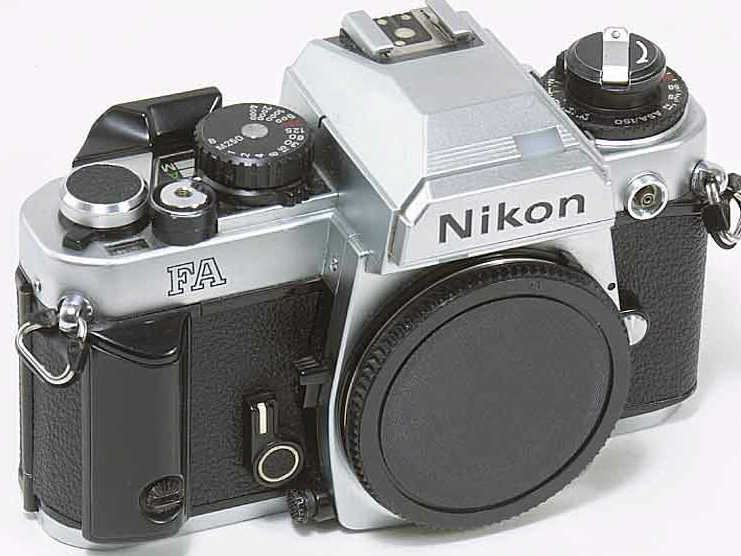
Nikon FA
In September 1983 a very sophisticated camera (for those days), related to the FM/FE-series was introduced: the Nikon FA.
It is the world´s first camera with multi-pattern metering (AMP), enabling to choose from P (Program), A (Aperture priority), S (Shutter priority) and M (Manual). LCD-window in the viewfinder, flash sync of 1/250 sec., exchangeable viewfinder screens and many more. The MD-11 and MD-12 can be fitted as well, although Nikon developed a special motor drive MD-15, which feeds the battery inside the camera too. This Nikon FA was the start of Nikon´s success with cameras with automatic exposure programs. Even the professional Nikon F4 has borrowed some features from this camera. A pity that this camera hasn´t received a great attention in the world of professional photography. Serial numbers of the Nikon FA started at 5000001. For all cameras mentioned above 2 data backs (MF-12 & MF-16) could be ordered. The MF-12 can be fitted on all cameras, but it only works if connected via a cable to the flash contact on the camera´s front. The MF-16 doesn´t need that cable. Both have a built-in clock (running up to the year 2100).
|