Nikkor autofocus standard lenses
AF-/S-Nikkor 1.4/50 mm, AF-/S-Nikkor 1.8/50 mm. and AF-S Nikkor 1.4/58 mm. Since most photographers are using a digital reflex camera + standard zoom lens, most standard lenses with a fixed focal length are overshadowed. The focal length of the mentioned and still available lenses are a bit too long for the use on a DX-framed digital reflex camera. For portrait photography they are fine optics, although some field curvature may occur at short distances. Nikon Corporation introduced rather late a lens for its DX-digital reflex cameras, that may be considered as a standard prime lens (those with a focal length of 35 mm.) Others - like the Sigma 30mm. - introduced standard lenses for digital cameras, but nearly all photographers are used to the wide range of zoom lenses that are available nowadays. And......it must be confirmed that Nikon Corporation produced and still produces very nice and needle-sharp zoom lenses with a large variety of focal lengths. Nevertheless all five lenses mentioned here are very nice lenses, especially when it comes to low light or available light photography (e.g. in theaters, museums and places where flashes are not wanted). As there are no zoom lenses with a maximum aperture of f/2.0 or larger these five relatively fast lenses are a must in every camera bag. And since Nikon offers digital SLR cameras with FX-sized sensors the need for a fast standard lens returns. The prices of these lenses - new or used - can´t be a point at issue.
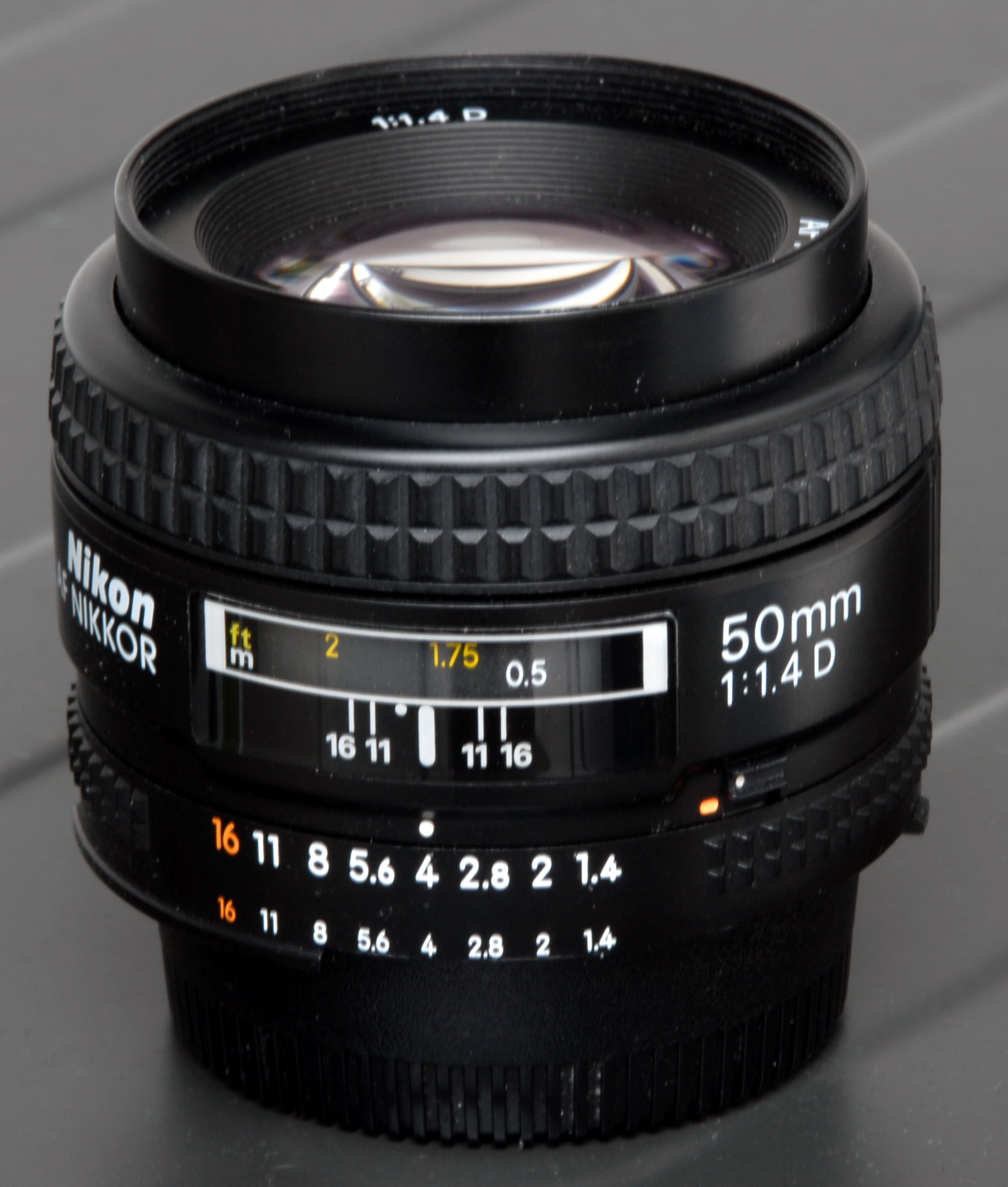
AF-Nikkor 1.4/50 mm.
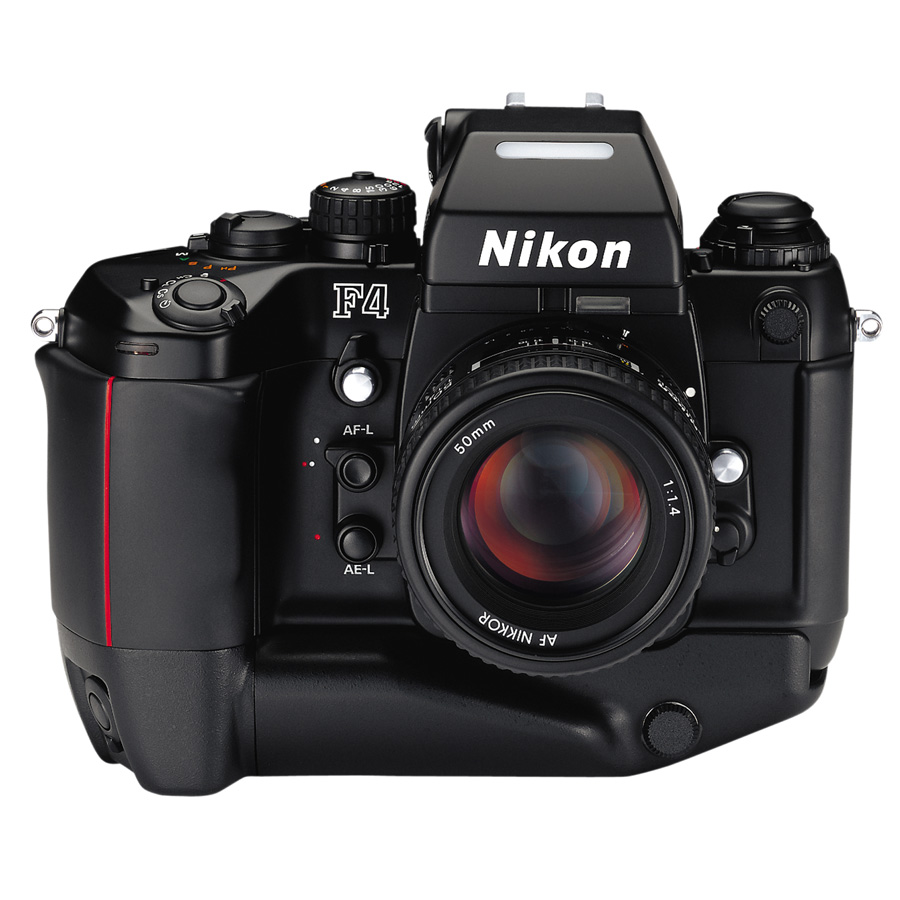
AF-Nikkor 1.4/50 mm. mounted on a Nikon F4 The history of this lens goes back to July 1950, when Nikon introduced a lens for its rangefinder cameras with the slogan ´faster than the 1.5/50 mm.´. The first autofocus version of this lens was introduced together with the first Nikon autofocus single lens reflex camera - Nikon F-501 - in September 1986. Of course this lens has a different optical and mechanical design and an advanced coating on all 7 elements (in 6 groups). This first AF-version is (unfortunately?) an all-plastic lens, although all lens elements are of optical glass. The aperture lock has to be turned, while of later versions that lock is a (sort of) switch. Manual focusing is difficult due to the very narrow focusing ring. In June 1991 a version (see below) is introduced with a wider focusing grip and the before mentioned aperture switch. Distances can be controlled behind a little window. Serial numbers of the first AF-version start at 2000001.
In April 1995 Nikon introduces a newly designed lens (6 elements in 5 groups), although the external design remains nearly unchanged. Early 2000 the production of this lens starts in China; thus most older AF-lenses are ´made in japan´, while the later versions are ´made in china´ (from #4500001). The last version is a D-lens, indicating the distance data transfer in order to improve flash photography. Performance of all versions is just excellent.
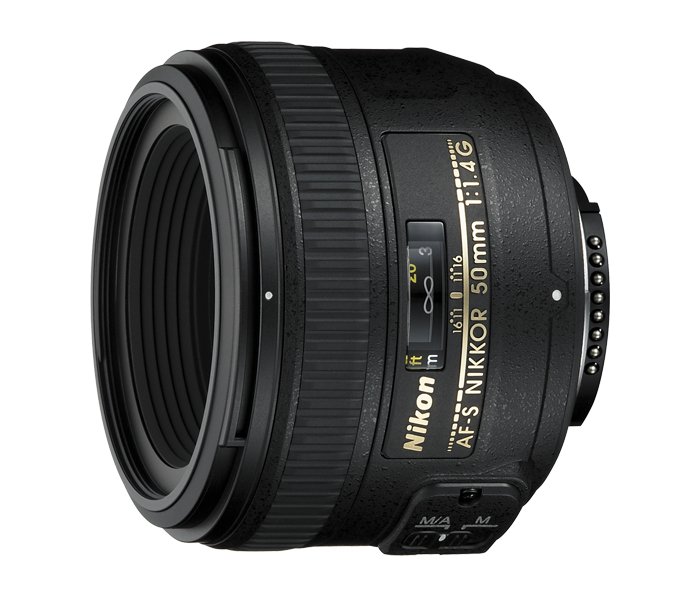
AF-S Nikkor 1.4/50 mm. G
At the opening day of the 2008 Photokina in Germany Nikon announced a brand new auto focus standard Nikkor in G-mount. This newly designed lens has 8 elements in 7 groups, has an aperture range of f/1.4 - f/16 and can be focused down to 45 cm. It has a built-in silent wave motor for fast focusing. With 9 aperture blades Nikon promises a nice bokeh! Although the entire optical system is moving - while focusing - the physical length of the lens will not change. Because the lens has a G-mount it will only fit cameras with electronic contacts in its lens mount. In addition to that the lens has no auto focus drive shaft, so it cannot be operated in AF-mode on some single lens reflex film cameras and the Nikon D40 and Nikon D60. The G-mount also prohibits the use of this lens on a Nikon PK-11a or bellows for macro-photography. The new lens has a filter thread of 58 mm. and weighs in at 280 gram. The front lens lays rather deep in the lens body, nevertheless a special hood (HB-47 with bayonet) is available.
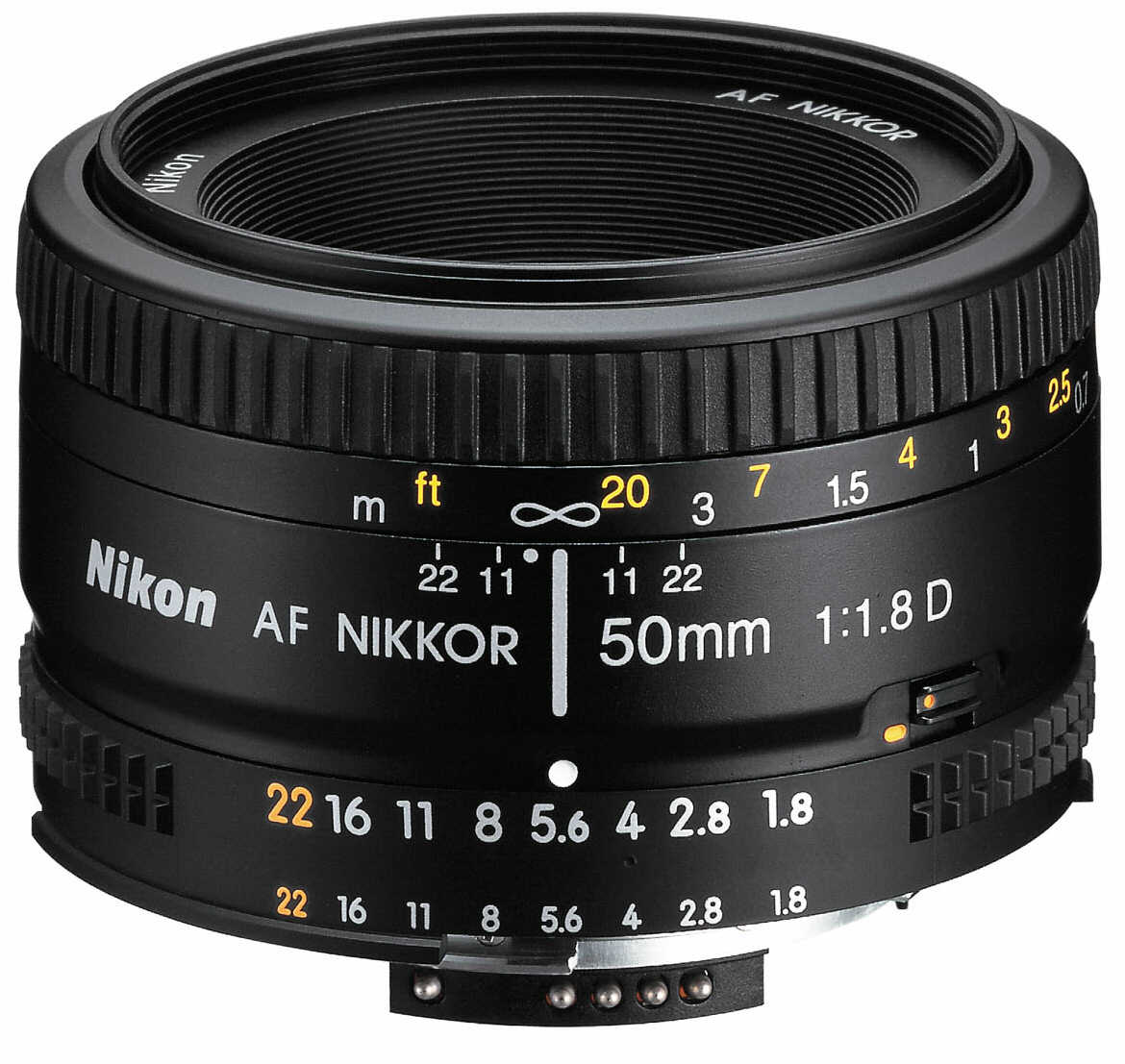
AF-Nikkor 1.8/50 mm.
In 1986 Nikon Corporation introduces this lens together with the abovementioned lens and camera. The design is almost identical to the latter f/1.4-version. Its focusing ring is far too small, that´s why Nikon introduces a slightly redesigned lens in 1990. In February 2002 Nikon surprises the world of photography with a brand new design of the AF-Nikkor 1.8/50 mm.! This beautiful, relatively cheap and needle-sharp lens is a D-version, useful for flash photography and matrix- and 3D-metering. Its performance at all apertures is excellent. Even for macro-photography - with or without a PK-11a macro-ring - this lens is better than its (a bit) faster brother.
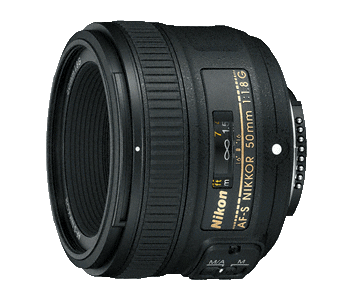
AF-S Nikkor 1.8/50 mm. G As it sometimes happens with Nikon Corporation's announcements, on April 19, 2011 a new version of this lens leaked to the internet: the G-version with a built-in Silent Wave Motor! The official introduction was 8 days later.
The new lens has a completely new optical design: 7 elements - of which one is aspherical! - in 6 groups with 7 diaphragm blades. That aspherical element in the design is a surprise in a standard lens with a maximum opening of f/1.8 !! The lens features a Silent Wave Motor for easy and silent focusing, autofocus with manual override and manual focusing. It can be used on all digital SLR cameras. The lens focuses down to 45 cm., weights in at 185 gram, uses 58 mm. filters and the HB-47 hood.
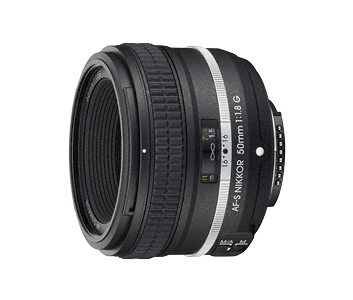
Early November 2013 Nikon introduced - together with the Nikon Df - a 'Special Edition'-version of this lens, having identical technical specifications, but a somewhat nostalgic looking body.
AF-S Nikkor 1.4/58 mm. G
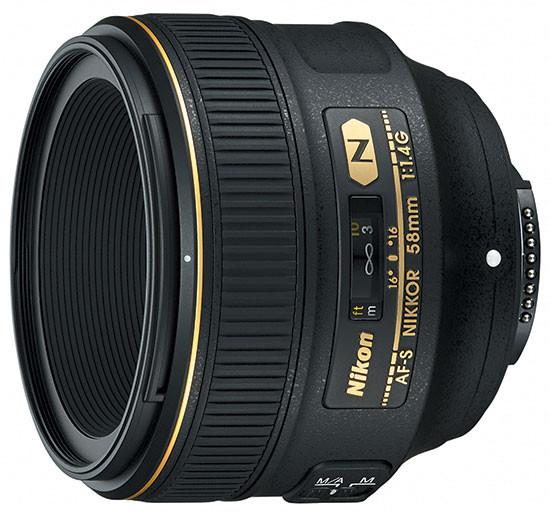
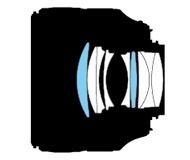
Mid-October 2013 Nikon Corporation surprised the world of photography with a very nice and fast standard lens for its full-frame digital SLR cameras. At the introduction Nikon refers to the famous Noct-Nikkor 1.2/58 mm. The new lens is half a stop 'slower' to eliminate aberrations and light fall-off wide open. Exposure meters built-in in all SLR cameras are not able to measure the difference anyway, so what? The new fast lens has 9 elements in 6 groups, including two elements with an aspherical surface (see above in blue) and nano crystal coating. This should reduce coma in the far corners of the image and less flare and ghost (internal reflections). The diaphragm has 9 blades for a nice bokeh. The lens weighs in at 385 gram. and has a filter thread of 72 mm. The best hood is the Nikon HB-68. The built-in Silent Wave Motor guarantees fast (rear) focusing, unfortunately only on the modern cameras as there is no mechanical coupling nor a AF drive shaft nor an aperture ring. After various tests it is clear that this is the best standard AF-Nikkor (in F-mount) Nikon has ever build. Though, given its hefty price, for available light photography a built-in Vibration Reduction feature would have been unique! For both older lenses - mentioned in this chapter - several hoods are available as they have a 52 mm. thread: HN-5, HN-6, HS-1, HS-2, HS-3, HS-5, HS-6, HS-7, HS-9, HS-11, HS-12, HR-1, HR-2 and HR-4. In the lens manuals not all hoods are mentioned, but as all hoods are made for the use on lenses with a focal length of 50 mm., they all will fit.
|