Nikkor autofocus short
tele-lenses
In the
short focal range tele-lenses Nikon was rather late. And the choice
has never been as widely as competitors were and are offering. But
the lenses Nikon offered/offers in this range are the best available
on the market. The 2.8/180 mm. can be used wide open without any problem.
If aperture is closed by one or two stops images (contrast) will slightly
improve. Closing may gain more DOF but image quality beyond an aperture
of f/8 is decreasing. These lenses are meant to be used at full aperture.
As we all know the three main colors (RGB) may not come together on
the film plane due to aberrations, both lenses have elements made
from special glass: ED (= Extra Dispersion) glass made by Nikon Corporation
via a secret recipe in its own melting 'pot', resulting in a breaking
index which eliminates nearly all color fringing and aberrations.
Various testers may discuss about a certain number of lines per millimeter
when comparing these lenses with similar products of other manufacturers.
But it's not all lines and millimeters. The total image transfer to
the film or sensor is what counts. And that's beyond any discussion!
AF-Nikkor 2.8/180 mm.
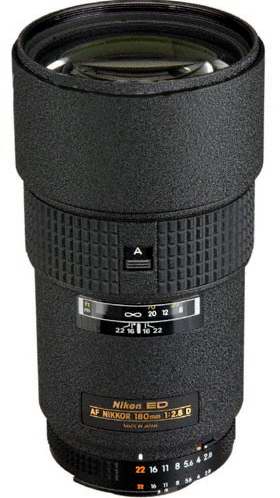
The lens
with this technical specifications has a long history. The German
dictator A. Hitler wanted to use the 1936 Olympics as his showroom
for - among others - innovative German products. Lens maker Carl Zeiss
showed his Olympic-Sonnar 2.8/180 mm. Nikon countered almost 20 years
later in 1955 with a slightly faster Nikkor S.C 2.5/180 mm. for its
rangefinder cameras. For the SLR cameras a similar lens was introduced
in 1970: the Nikkor-P 2.8/180 mm. This popular lens underwent several
technical and optical changes, like the introduction of a version
with ED-glass in the 1980's. The first auto focus version was marketed
in Summer 1988. This version was modified as well, resulting finally
in the AF-Nikkor D 2.8/180 mm. IF-ED. Despite what competitors are
trying to prove, this lens is the very best available on the market!!
Needle sharp at all apertures with a very nice DOF and bokeh!
This last
version has an optical construction of 8 elements in 6 groups, The
second element from the front is made of that special ED-glass. Via
the internal focusing system it can be focused down to 1.5 meter.
It has a built-in hood and takes 72 mm. filters and weights in at
760 gram. Mounted on a DX digital SLR you'll have a super fast 2.8/270
mm.!
AF-Nikkor 3.5/200 mm (for
Nikon F3-AF)
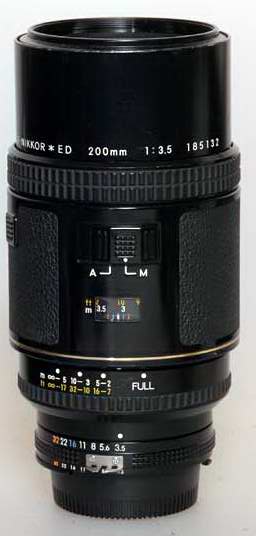
In
1983 NIkon showed the world that it was ready for auto focus photography.
Together with the Nikon F3-AF it introduced two auto focus lenses:
the AF-Nikkor 2.8/80 mm. and this nice and sharp tele-lens, the AF-Nikkor
3.5/200 mm. The lens has an optical construction of 8 elements (one
element of ED-glass) in 6 groups, internal focusing down to 2 meter
and a built-in hood. Although it was meant to be used exclusively
on the Nikon F3-AF it will work on e.g. the Nikon F4 as well.
AF-Nikkor
2/200 mm. ED
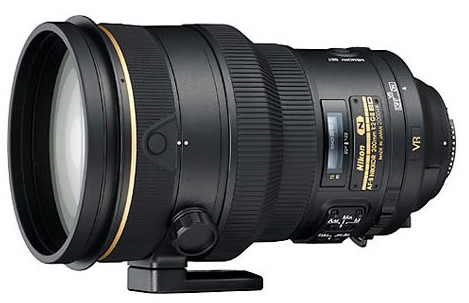
In September
2004 a very sophisticated version was introduced: AF-S VR-Nikkor 2/200
mm. IF-ED G. Translating this long series of letters tells us that
this lens has autofocus (AF), a built-in silent wave motor (S), an
electronic vibration reduction facility (VR), internal focusing (IF),
3 elements (out of 13) made of extra-dispersion glass + 1 of ´super-ED-glass´
(ED) and - finally - a G-lens mount (G). The latter mount limits the
use of this lens on G-mount cameras only. This very nice lens - weighting
in at nearly 3 kilo - delivers razor sharp images at all apertures.
The VR-system avoids vibration, even if you are sitting e.g. on a
motorbike. If used with a Nikon tele-converter (TC-14E II, TC-17E
II or TC-20E II) very fast tele-lens-combinations can be made; all
with VR!